



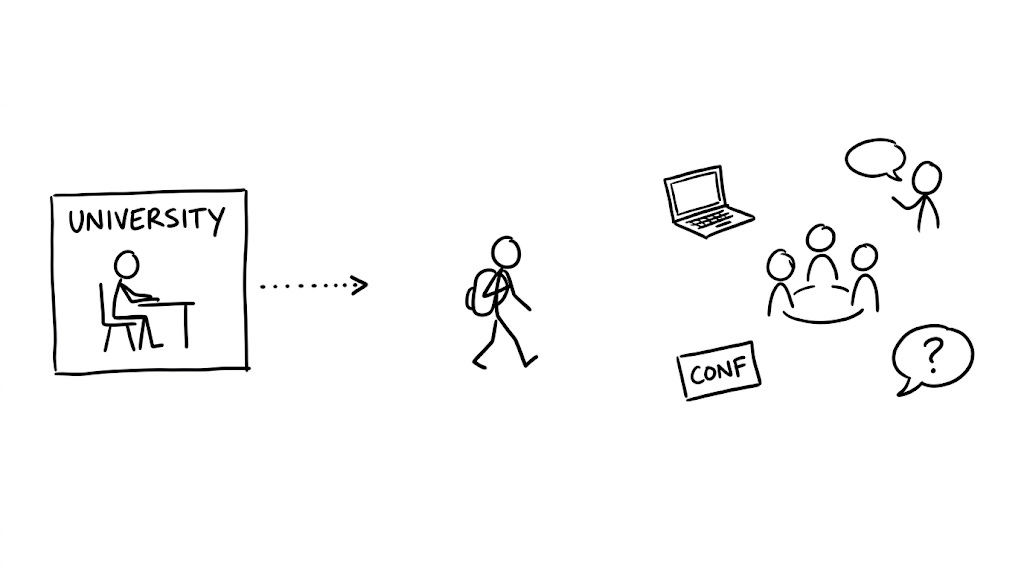
I had a chat with Mihail, a software engineering lead who also lectures at Plovdiv University. He teaches data engineering as an elective because the core CS curriculum has zero room for it.
That tells you everything about the state of data education.
Universities produce graduates who know SQL syntax, basic normalization, and enough theory to pass an exam. Then those graduates walk into jobs where the theory is the easy part. The pipelines, the warehouses, the cloud platforms, the stakeholder conversations, the ambiguity of real problems. None of that shows up in a lecture hall.
I got my databases grade in university and it was mediocre. I didn’t care because the course felt abstract and disconnected from anything real. Most students feel the same way. And the system does nothing to change that.
The gap between what university teaches and what the job demands keeps growing. But the fix is simpler than most people think, and it starts long before graduation day.
The Curriculum Stops at SQL
University data education peaks at a single databases course in your second year.
You learn what SQL is, what a database does, and some theory about normalization and data storage. The course is abstract. Students treat databases like glorified Excel files because nobody shows them why the syntactical overhead matters.
Until you work on large-scale projects, the difference between a spreadsheet and a relational database feels like a bureaucratic formality.
And that databases course is the baseline for everything data-related in the entire degree.
Everything Beyond SQL Is “Too Specialized”
From that point, data science branches into math and statistics. Data engineering branches into pipelines, warehouses, cloud platforms, ETL, governance. The university follows neither branch with any depth.
The reason is structural. Introducing a new subject into a CS curriculum takes years of bureaucratic and administrative effort.
Universities teach foundations because foundations are stable. Specific technologies move too fast for a system designed to change slowly.
SQL is foundational enough to make the cut
Snowflake, Databricks, dbt, Airflow are all “too specialized”
Anything resembling a real data engineering stack gets classified as professional training, outside the university’s scope
The 10-Year Lag Is Built Into the System
Mihail put it bluntly. Universities are roughly a decade behind the industry. By the time a discipline earns a permanent spot in the curriculum, the profession has already moved on to the next generation of tooling.
The workaround at Plovdiv University is elective courses. Mihail and his colleagues created an entire data engineering track outside the required curriculum.
Students who are dedicated sign up semester after semester and piece together the big picture on their own initiative. A full data engineering discipline exists in the master’s program, but only because individual lecturers pushed for it.
The core curriculum still treats data engineering as a niche profession. The students who figure out it matters do so despite the system, not because of it.
Hard Skills Used to Be Enough. They Aren’t Anymore.
A few years ago, knowing one programming language and one framework got you hired.
The COVID-era hiring boom rewarded narrow skill sets. Companies needed seats filled. They needed people who could write code in a specific technology and ship tickets.
Thousands of junior developers entered the industry every month on the back of a single concentrated skill. No curiosity required and no product understanding expected. Know React, get a job.
That worked because the economics supported it.
The Market Shifted and the Craftsmen Got Stuck
The economics changed. Companies stopped hiring for volume. AI tools absorbed the foundational knowledge work.
People who built their entire career around one framework or one language found themselves competing with a chatbot that explains object-oriented programming better than most university courses.
Information is everywhere now. What separates a valuable engineer from a replaceable one is everything around the information.
Understanding the product and the customer
Adapting when the tooling changes underneath you
Operating with judgment in ambiguous situations
Communicating with stakeholders who speak a different language than you do
Universities Still Train for the Old Game
The university teaches you how to use tools. The job requires you to understand why you’re using them and what problem they solve for the business.
Mihail made a sharp distinction. Universities produce IT people, not developers. The degree gives you logic, math, and a surface-level tour of programming concepts.
But the industry needs people who solve problems related to communication, technology, and economics. Those are three different skill sets, and a CS curriculum addresses one of them on a good day.
The people who stall are the ones who treat graduation as the finish line. The ones who keep going treat it as a starting point for a much longer education that happens inside the business, inside the community, and inside the messy reality of real projects.
Your Network Is Your Actual Career Engine
The cliche says your network is your net worth. It holds true even when you look for a job.
Blasting CVs across LinkedIn is the path of least resistance. It feels productive because you’re doing something. But it’s a low-leverage move that puts you in a pile with hundreds of other applicants who look identical on paper.
Mihail’s company has never posted a single job offer on a popular platform. They hand-pick students directly from the university. Every hire comes through relationships built during lectures, projects, and community events.
That pattern repeats across the industry more often than people realize.
Show Up Where the Decisions Happen
Conferences and user groups are where project leads, hiring managers, and senior engineers gather to talk about the work they care about. These people are approachable in that setting. They want to talk shop.
The move is to ask about their problems, not their openings.
What kind of scaling challenges are you dealing with?
Where does delivery break down on your projects?
What does your data stack look like and where does it hurt?
These questions signal curiosity and understanding. “Do you have any open positions?“ signals desperation.
One leads to a conversation. The other leads to a polite nod and a business card that goes nowhere.
Make Yourself Visible Before You Need a Job
If you’re early in your career and don’t have deep experience to share, you still have options. A GitHub project, a blog post about a technology you’re learning, a short tutorial, a LinkedIn thread documenting what you figured out this week. None of these need to be brilliant. They need to exist.
Visibility compounds. The people who run conferences and user groups see the same faces year after year. They remember your questions, and when a role opens up on their team, they think of the person they’ve been talking to for the last six months before they think of the 200 CVs sitting in their inbox.
I found my current company through conferences. Several people I’ve worked with came from user groups and community events. This is how the industry works when you look past the job boards.
Find Misho
Here’s how you can find more about Mihail and his initiatives for data newcomers.
Everything he does at this point is in Bulgarian, but Mihail promised to start building educational content in English, too.

Closing Words
The university gives you a starting line. Logic, math, a community of confused peers who share your ambition. That matters more than the cynics admit.
But the finish line is somewhere else entirely.
The skills that make data engineers valuable are built in the space between academia and industry. Pipelines, product thinking, stakeholder conversations, judgment under ambiguity.
No curriculum covers this. No lecture hall prepares you for the moment a stakeholder asks you to scope something that has never been done before and expects an answer by Thursday.
The people who figure this out early have an unfair advantage. They show up at conferences while still in their second year. They build side projects that prove curiosity, not mastery. They surround themselves with people who are ahead of them and ask questions until the vocabulary clicks.
The people who wait for a curriculum to teach them what the job demands graduate with a degree and a gap where their career momentum should be.
University is a foundation. Treat it as one. Build everything else yourself.
—
Yordan


