


Let me tell you what I see all the time.
Product drops a ticket asking for a churn model. Marketing wants a pipeline for campaign attribution. Someone from finance needs a new metric in the warehouse. And the engineer opens their editor and starts building.
No questions asked. No pushback. Just execution.
I get it. You want to be helpful. You want to look productive. You don’t want to be the person who complicates things with twenty questions when someone just wants a model.
But here’s the problem: the request is almost never the real problem.
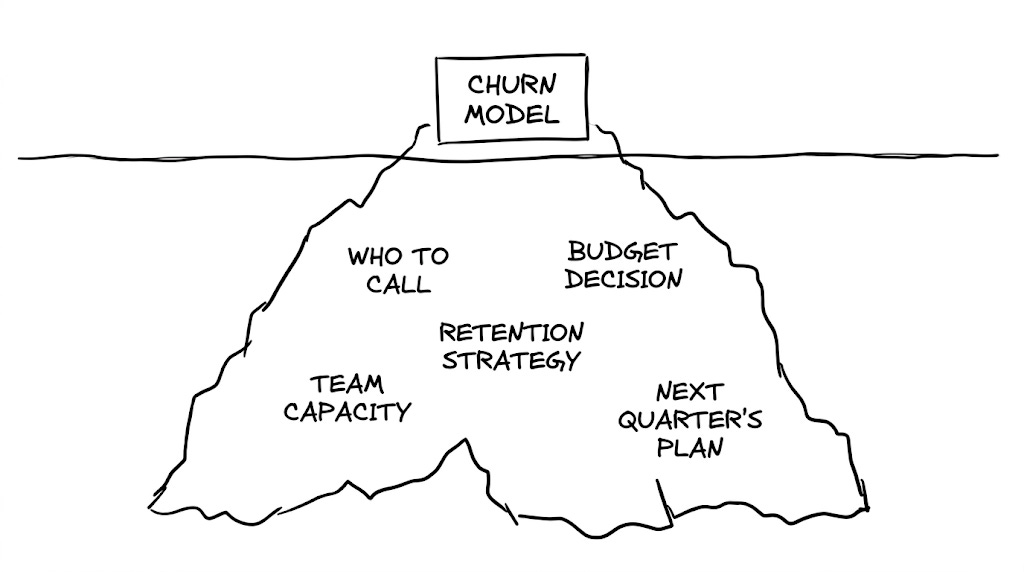
Stakeholders Are Guessing
When someone asks you for a churn model, they are not a data scientist who has diagnosed the problem and prescribed the solution. They are a business person who has a problem they cannot solve and has translated it into something they think you can build.
That translation is almost always wrong.
A product manager who wants a churn model is usually trying to answer a much simpler question: who should the retention team call next week? Marketing asking for attribution is not an analytics project. They want to know which channels to cut and which to double down on before the next budget cycle.
The model is not the answer. It is their guess at what the answer might look like.
When you accept that guess without questioning it, you start building the wrong thing. You ship it, nobody uses it quite right, and three months later there is another request that is a slightly different wrong guess.
This is the customer service trap. You close tickets instead of solving problems. You get very efficient at producing outputs that do not change anything.
Why You Keep Doing It
You already know this happens. You have seen it. You have built the model that sat on a dashboard nobody opened.
So why do you still start building the moment the request lands?
Because slowing down feels uncomfortable. The second you ask “what decision does this actually support?” the conversation gets heavier. The stakeholder gets defensive. The request that seemed simple suddenly has no clear answer.
Most engineers avoid that moment. It is easier to just start building.
And your organization rewards you for it. Closed tickets are visible. Pipelines deployed are visible. The conversation where you figured out that nobody actually needed a model, that conversation is invisible. Nobody puts it in a sprint review.
So you keep executing. And the ambiguity moves downstream, buried inside a system that runs perfectly and helps nobody.
The One Conversation That Changes Everything
The difference between an order taker and someone who actually moves the business forward almost always comes down to a single moment: the first conversation after the request arrives.
Order takers treat the request as instructions.
I am not saying you need to interrogate every stakeholder for an hour before writing a line of code. I am saying you need to ask two questions before you start: what decision does this output support, and what changes after you have it?
That is it. Two questions.
When you ask them, something interesting happens. The request starts to fall apart or change shape. The churn model becomes a prioritization spreadsheet. The attribution pipeline becomes a simple analysis of three channels. The activation metric becomes a conversation about what the product team is actually trying to decide.
Sometimes the real problem has nothing to do with data. Sometimes it is a broken process or a misaligned team or a goal that nobody has defined clearly. You find that out fast when you ask what changes after the output exists.
And once you know the actual problem, the work gets smaller. Faster. More useful.
What This Does for Your Career
Here is the part nobody talks about.
When you keep executing requests without questioning them, you train your stakeholders to treat you like a vending machine. They put in a ticket, they get an output. They never think to bring you in earlier, when the problem is still being defined, because they have learned that is not what you do.
You become a very skilled, very expensive order taker.
The people who get asked to sit in on strategy calls are not the ones who are fastest at closing tickets. They are the ones who have shown they can reframe a bad question into a useful one. They have made someone’s problem smaller and cleaner before any work started.
That is the reputation worth building.
Once you start doing this consistently, you will also notice the work gets better fast. And you will realize that the conversation itself needs structure, or the same ambiguity comes back with the next request.
Talk soon,
Yordan
PS: A lot of paid members tell me they got promoted after working through the resources inside. If that sounds relevant to where you are right now, grab your membership now.