There is a moment you hit as a senior engineer and almost nobody warns you about. The learning that used to feel automatic starts to slow down. The gaps between “I learned something real today“ get longer. Weeks, sometimes months.
Most people read this as a personal failure. You assume you have gotten lazy, or comfortable, or that the hunger that made you good is fading. You start chasing certifications or side projects to feel the velocity again.
The velocity does not come back. And chasing it is the wrong move.
What actually happened is that your horizon changed. When you were building things, feedback arrived fast. You wrote the code, the tests ran, the pipeline moved. The learning was continuous because the signals were continuous.
When you operate, you make a decision in January and find out in August whether it was right. A different kind of learning, with a different rhythm, and almost nothing prepares you for it.
This piece is about how to keep growing when the old mechanisms stop working, because you outgrew them.
The Horizon Shifted
As an engineer, your feedback loop is tight. A PR merges, a pipeline runs, a test passes. You know within hours whether you did the right thing. That tightness is what makes learning feel fast. You get a signal, adjust, and move.
When your role grow, the signals take months:
You change a hiring process and find out a year later whether you hired well.
You restructure how your team runs projects and see the results two quarters down the line.
You invest in a stakeholder relationship and the payoff arrives slowly and quietly, instead of in a notification or a merge.
This is the job now.
If you still measure yourself by what you personally shipped this week, you will always feel behind. Not because you are behind, but because you are using the wrong ruler.
The New Ruler
So what do you measure yourself by instead?
Three things:
The team ships.
Stakeholders are happy.
The people on your team feel like they grow from working with you.
That is it. Those three are your new ruler. If all three are true, you are doing your job well. If any of them are consistently off, something needs your attention, regardless of how much you personally produce.
This feels uncomfortable at first, especially if you are used to clearing a todo list and knowing exactly where you stand.
These three things are slower to read and harder to fake. A stakeholder who tells you everything is fine in the meeting and escalates to your manager the next day is a signal you missed something. A team member who looks busy but stops bringing you hard problems is a signal too.
You learn to read these, but it takes time.
It also feels, like you are doing less at first. You are not shipping the pipelines, not writing the models, and not closing the tickets. The work is less visible and the feedback is slower. You are running a system instead of building a component. That is harder, and the leverage is orders of magnitude larger.
When your team ships well and your people grow, that is your output.
Own it as seriously as you owned every PR you ever merged. Even more.
Block the Time
All of this happens by design.
If you do not protect time for learning, the week fills up and learning is always the thing that moves to next week. Next week becomes next month. A year passes and you realise you have been reacting to the job rather than growing inside it.
Block two to three hours a week.
That’s non-negotiable. Put it in your calendar as a recurring block and treat it with the same respect you give your most important meetings. Because that is a meeting with your future.
You don’t need to do it in a single block. Thirty minutes at the end of each day works just as well. What matters is that it is regular and protected. The moment you start treating it as optional, it disappears.
What you do with the time doesn’t matter that much. Take a course, read a book, build something small, or even talk with a peer at another company. The medium is less important than the habit. The point is to keep a part of your attention pointed outward, at something that is not your current backlog, your current team, your current problems.
One thing worth noting:
Learning at this level is not mostly about new tools or frameworks.
A new tool is learnable in a day when you have enough context. What takes real time is developing judgment:
How to read an organisation.
How to run a hard conversation.
How to make a call with sixty percent of the information you want.
You build that slowly, through exposure and reflection. Tutorials won’t help you here.
The two to three hours a week is where that reflection happens.
The Learning Workspace
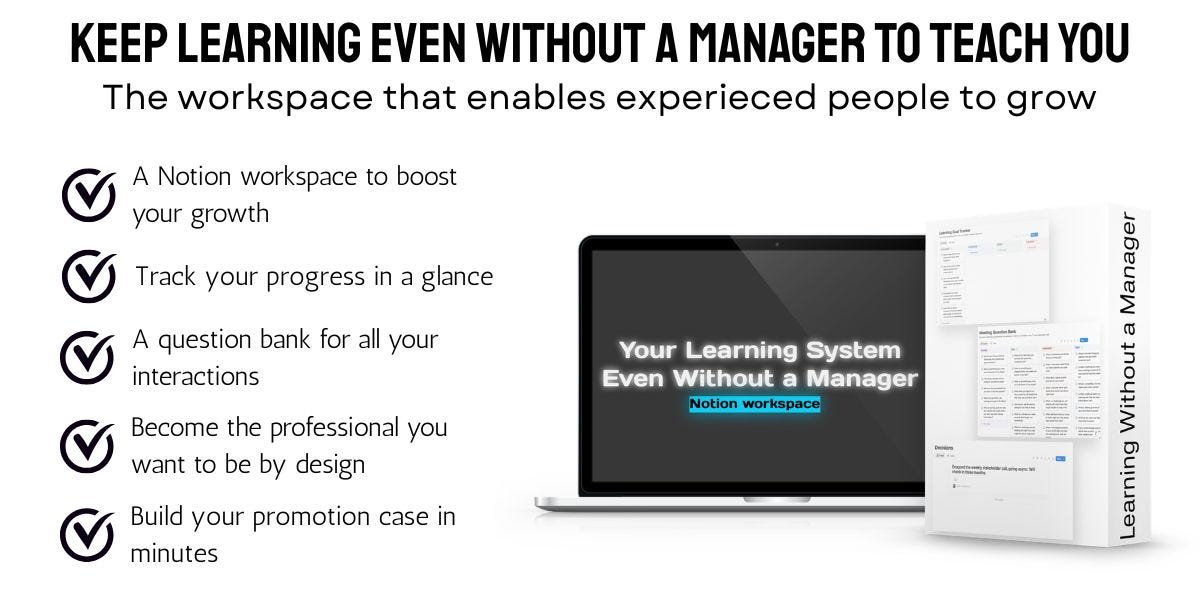
Learning without a strong manager who can really teach you the skills you need is hard. So, I packed some of my best tools to share them with you so you can design your career growth and become the professional you want to.