


I just got the Senior Data Engineer title. I started a Redshift cluster resize late in the evening, thinking I was being proactive. Two hours later, my phone rang.
A Redshift resize puts the cluster into read-only mode, causing us to stop processing payments. Customers attempted to give us money and our infrastructure refused them.
It was 10 PM, but I started hacking a solution to bypass the four-hour update window. By 10:30, the system worked and the money flowed again.
The clean code did not matter. I mastered the tools but ignored the operational risk. This is the gap between a technician and an operator. Many engineers spend years mastering a toolset only to hit a career ceiling because they focus on syntax while the business focuses on survival.
Seniority is a measure of dependability. If you fail to explain the business risk of your architectural choice, you are a junior with a high salary. Real seniority is the transition from a technical expert to a dependable operator who manages seven-figure liabilities.
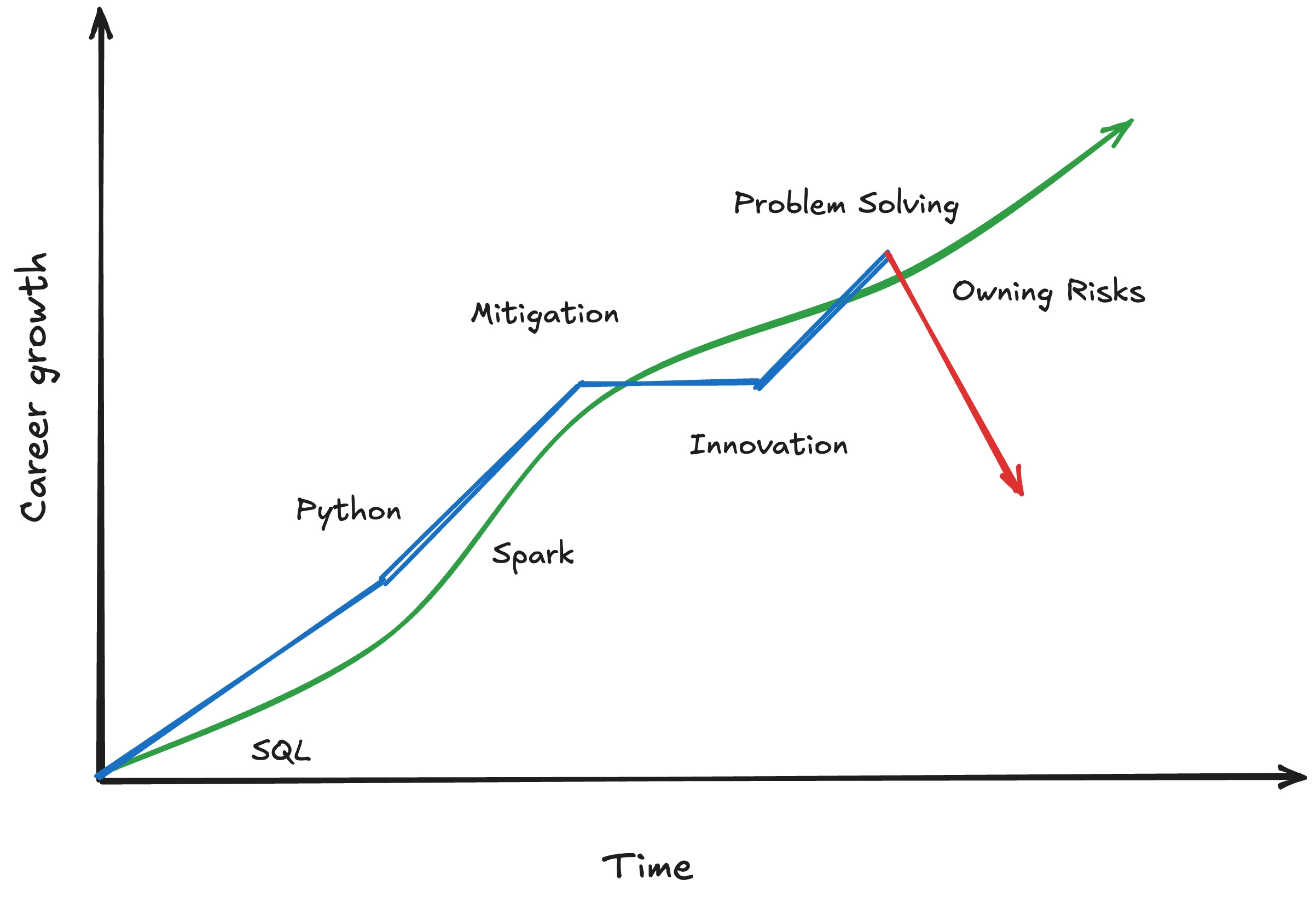
The Local Expert Mirage
My Redshift disaster happened because I mistook familiarity for seniority. I spent years in one environment. I knew every quirk of the ingestion framework. I knew the legacy tables to avoid and the pipelines requiring a manual kick.
The company granted the title because I stayed long enough to become the human documentation for a proprietary mess. I felt senior because I had answers for one specific office.
If expertise evaporates when you switch stacks, you never learned engineering. You learned a map.
True seniority survives a change in environment. You find yourself in interviews for Lead roles and realize you have no principles to build a new platform from scratch. You spent your time mastering internal politics and tribal knowledge instead of operational risk. You are a passenger. You trade future leverage for the safety of a terminal you already understand.
This comfort zone creates a ceiling. You stop growing because you are the big fish in a small, broken pond.
You hide behind the terminal.
Outside of your specific warehouse, you lack the skills to justify your salary. Real seniority requires you to leave the safety of the local setup. You must learn to build systems that work anywhere. You must learn the trade-offs of the industry instead of the habits of your coworkers.
Becoming A Load-Bearing Operator
Becoming a load-bearing operator means moving from code to outcomes. You support the weight of the business. You provide stability. When systems break, leadership looks to you for solutions instead of excuses.
This shift changes your identity. You stop being a generator of code and start being a component of the organization. Ownership replaces execution. The company pays for the silence of a working system.
Owning The Unit Economics Of Data
Every query you write is an invoice waiting to be sent. If you don’t know the price of your architecture before you deploy it, you are not a senior engineer, but a hobbyist playing with company money.
Technical experts focus on reducing latency by three seconds while ignoring the fact that the pipeline costs more than the annual travel budget. A load-bearing operator understands that data engineering is a business of margins. You must audit the unit economics of every table you build.
This starts with pre-calculation. Before the first line of code exists, you should know the monthly run rate. You look at the volume, the compute requirements, and the storage overhead. You identify where the business wastes money on low-value dashboards that no one opens after the first week.
If a stakeholder requests a real-time streaming job for a report used once a month, you do not build it. You explain the cost. You show them the real-time requirement adds $3,500 to the monthly bill for zero additional business value.
Provide options. A senior engineer gives the business a choice: one-minute latency for $5,000 or one-day latency for $400.
This shifts the conversation from technical limits to business decisions. When you quantify the cost of technical curiosity, you stop being a service provider. You become a filter for waste.
Trust is earned when you prove you will not bankrupt the department to satisfy a technical whim.
Leadership hands seven-figure budgets to people who treat company cash like their own. You earn the right to lead when you show you care more about the survival of the organization than the elegance of the join. You optimize for the bank account first and the performance second.
Architecting For Day Two Operations
Building a pipeline is easy, but maintaining it for three years is the real challenge. This means assuming the system fails and building recovery into the architecture from the start.
If your pipeline requires manual intervention to restart after a network blip, you failed. If your documentation exists only in your head, you created a liability.
Load-bearing operators prioritize observability over cleverness. They build for the engineer inheriting the code. They choose boring, proven tools because these tools do not surprise the team with undocumented bugs. This is the difference between an engineer and someone who plays with technologies on the company’s time.
Day Two operations require you to sacrifice ego for stability. You avoid the feature if it adds a layer of complexity the team is unable to support. You write code for clarity, not to show off knowledge of functional programming. You build alerts providing context instead of noise.
When a system breaks, the logs must tell the operator what happened and how to fix it. If an on-call engineer needs to call you to explain a log message, your design is incomplete.
Idempotency is a requirement here. An operator ensures a pipeline runs five times and produces the same result without duplicating records. This removes the fear of the “Re-run” button in Airflow. You design systems allowing for partial failures without corrupting the entire dataset. This precision separates the senior engineer from the person who fixes data via manual SQL scripts on a Monday morning.
This approach reduces the cost of ownership. Companies waste millions on high-salary engineers spending half their week fixing broken legacy systems.
You break this cycle by architecting for resilience. You implement health checks catching data quality issues before they reach the warehouse.
This protects stakeholders from making decisions based on bad numbers. You ensure the system remains a utility, not a constant source of anxiety for the department.
Negotiating The Definition Of Done
Junior data engineers close tickets, and seniors solve business problems. This distinction defines your career trajectory. If you accept every request without question, you remain a service provider.
You function as an order-taker for data. Real seniority involves interrogating the request until the business need appears. You must strip away the technical ego to find the logic underneath the Jira ticket.
Stakeholders rarely know what they require. They ask for a new pipeline because they saw a trend or feel a vague anxiety about a metric. You must ask why. You must understand the decision following the data delivery. If no decision exists, the pipeline should not exist. You save company resources by refusing to build monuments to vanity metrics. This represents the difference between an employee and an operator. An operator protects the company from its own bad ideas.
Negotiation serves as your tool for risk management. You discuss the definition of success before any ticket enters a sprint. You move the goalposts toward simplicity. You suggest a manual export if the task saves three weeks of engineering time. You explain the operational debt of a feature.
You trade technical perfection for business speed.
This requires the confidence to push back on leadership when their ideas create liability without profit.
It is easier to say yes and complain about the workload later. An operator says no.
You protect the team from the chaos of changing requirements. You define success by the outcome, not the lines of code. When you narrow the scope to the essential, you reduce the surface area for failure.
This ensures the seven-figure budget produces a return instead of a pile of unused dashboards. You earn the trust of the organization when you prove you care more about the result than the process.
Final Thoughts
The industry is correcting. The era of the high-growth builder who earns a promotion for occupying a seat for two years is dead. Companies no longer have the appetite for technical debt or unmonitored cloud bills. They want stewards.
We are moving from a world of breaking things to a world where a broken pipeline represents a massive financial liability.
Success in data engineering used to mean mastering a complex stack. Now, success means making the stack invisible.
You want to be as reliable as the power grid. Nobody celebrates the power grid until the lights go out.
Seniority is not a destination or a salary tier. It is the moment you stop caring about the tools and start caring about the survival of the business. You will know you reached it when leadership asks for your opinion on a strategic move because they trust your judgment as much as your code. Tools will change. Vendors will go bankrupt. Your ability to manage risk is the only asset you keep. You are an operator now.
Thanks for reading,
Yordan