


I spent years believing that a happy stakeholder was the ultimate metric of success. I thought that if I fulfilled every request quickly, I was beign a “team player“.
I was wrong. I was just building a service desk.
When you treat data engineering like customer support, you signal to the entire organization that you are a cost center, not a partner. You become the person people go to when they want a specific CSV or a minor dashboard tweak, but you are never the person they call when they are deciding the future of the product.
This behavior creates a cycle of reactive firefighting that buries your best talent under a mountain of trivial tasks. If you want to lead a high-impact team, you have to stop serving and start operating. This means shifting from fulfilling requests to owning outcomes.
If you stay in chaos, you’re a victim. If you hide behind Jira, you’re a bureaucrat. Neither of these roles gets a seat at the table when the real decisions are being made.
What Most Data Teams Do
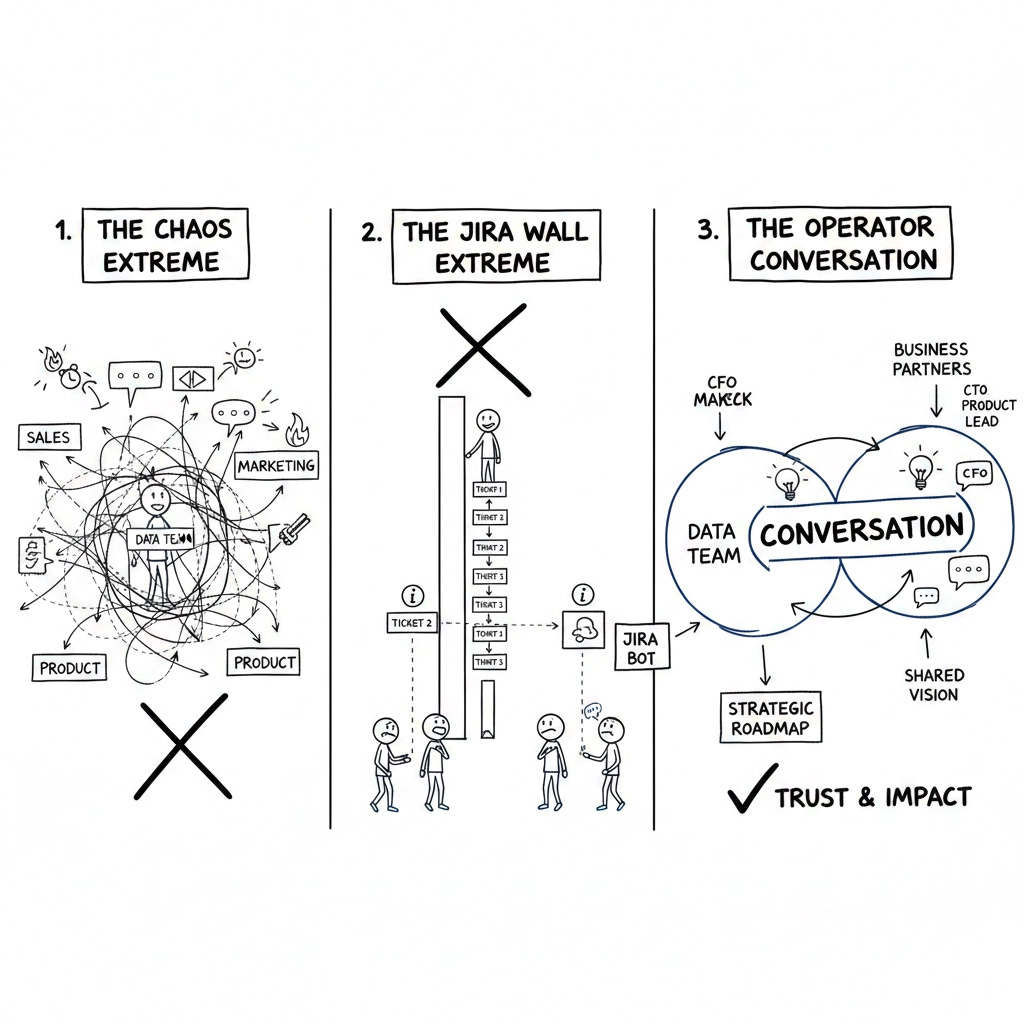
Most data teams fall into one of two extremes. They either live in pure chaos or they hide behind a wall of tickets.
On one end of this spectrum, you pick tasks from the most vocal stakeholders.
You start working on a marketing pipeline on Monday. Then a sales manager asks what happened to the task you promised last week. You drop the marketing project to keep the peace. Then the marketing lady follows up again. You hop back to marketing.
Everyone is shouting about how urgent their thing is. You jump from project to project and end up late on everything.
Stakeholders don’t trust you because you never meet a commitment. But they love it. They know if they just get loud and push you every day, you will act like a code monkey and do whatever they say.
The other end is the Jira wall.
Someone asks for a simple report and your Slack bot tells them to fill out a form. The ticket goes into the backlog and you pick it when you feel like it.
This is great for the data team because you don’t feel any stress. You just work through the list. But for the business, this is a terrible experience. People can’t explain the priority of a project and it feels like they can’t rely on you for anything that actually matters.
Why This Hurts Your Growth
When you act like a service desk, everybody treats you like a service desk. Nobody asks for your opinion.
I mean, you would never ask customer support how to run your business. You might ask them for details on how to reset your password, but you would never treat them as a partner in your business.
Engineering might feel like a solitary endavor, but success in data really isn’t.
Here is how it actually looks in your organization: You have the expertise and the know-how to build the new AI initiatives. But you’ve signaled that your job is just to do what you’re told. So your organization hires consultants or contractors instead. They might even hire a new lead to run the project you actually wanted to work on.
Because you don’t show your expertise in actual conversations, nobody knows you have the desire. Nobody gives you the opportunity. Somebody else gets the title and the budget.
You might be an essential part of the work, but nobody mentions your name and you have nothing for your CV.
I’ve seen this happen over and over. People feel overlooked and they quit because they never got a chance to prove themselves. You’re getting left behind while you close tickets.
What To Do Instead
The solution is actually very simple: Ditch Jira. I am serious. Stop asking people to “quickly put a ticket“ on your board. Forget about that immediately.
Every time someone comes to you, start a chat with them on Slack. Ask them what they want and why they want it. Figure out how important it is and what the end goal is. Talk to them.
Data leadership is not just about pumping out pipelines. It is more about conversations. So, if needed, hop on a short Zoom call.
When you are done talking, summarize everything on Slack. Give them a clear estimation of when you can do it. Maybe it is now. Maybe it is a month. Maybe it is a straight “no.” But you need to be clear about when and why.
You do not need to do things the way they envision them. If you have ideas up front, that is amazing. If you don’t, spend a couple of days doing research and drawing architecture diagrams. Restart the project with a clear plan and suggestions. Give your advice. Prove you are an expert, not just a tool that says “yes, ma’am“.
Because here is the paradox: The more you say no, the more people respect you and listen to your advice.
But you cannot prioritize or say no without a strategic vision. You must have a proper roadmap of what you want to do and what the company roadmap looks like. Your CTO or CFO can only back you if you have a clear vision and strong alignment with them.
“But Yordan, I work at a fast-paced startup”. I’ve heard that bullshit way too many times. You need the big vision. You need to know where the company is heading in two or three years so the platform can support that growth.
Make sure you don’t break your platform just to please one person.
How Success Looks Like
I need to warn you. I’ve lived this and seen it happen with data leaders I coach.
When you start acting as a partner and showing your expertise, everybody starts asking for your opinion. You get dragged into calls. A lot of them. You might not even have time to build because everybody wants your advice.
But someone needs to do the workm which means you’ll need to ask for more people and bigger budget. And you may get them. Even before you are mentally prepared to lead a large team.
But this is not what success really is to me.
Success isn’t measured in headcount. It is measured in how much the organization trusts you. If they ask for your advice on how to build things, or ask your opinion on a new technology they read about, or to lead a workshop for a department.
That is what success looks like. This is when you know your boss, and the boss of your boss actually trust you.
So even when it is time to move on, you can say you advised on this project or led that initiative. You’ll have a solid CV full of concrete examples, and people will be happy to give you recommendations. That is what real success looks like.
Final Thoughts
I’ve said this many times and I stick to it: In the age of AI, only true humans succeed. Anybody can ask a bot a question and get a generic “this is a perfect idea“ response.
If you act like that, you are replaceable. But if you show you understand the business goals and can drive real change, you become indispensable. The data world changes in the blink of an eye, and you need to be the one navigating that change, not just reacting to it.
This is the only way to get bigger budgets, higher pay, and the projects you actually want under your belt. It doesn’t mean you need to be aggressive. It just means you need to show you have ideas and that you are open to ideas from other people. In a sense, if I have to say it in one word: be easy to work with.
Thanks for reading,
Yordan
PS: Hit the ❤️ button. This is how I know you want to read more on that topic.
Your article is spot on. In my team we always groom the requests from the stakeholders (through human conversation) because they are not as familiar as we are with the data flow. We have seen cases that the request doesn’t even need to go to Jira as it can be self serve after all. So definitely requesters need some help from data teams in forming the request.
However, this doesn’t automatically give you a sit on the table where decisions are made.
I haven’t yet concluded whether it is ok for data teams not be that close to the business decisions or it is a state that needs to be improved as we deserve a sit there. If anyone here has experience would love to hear how you managed to become part of the strategic decision making and how the data team perceived it.