


I started applying the same processes I use at work to my own career and life. Logging decisions and why I made them. Running retros on myself, tracking where I wanted to go and whether I was actually moving in that direction.
At some point I noticed I was getting better faster. Writing forced me to actually process the information around me.
That’s the discipline most engineers never apply to themselves. They track everything at work and nothing about their own career. Years of decisions, hard lessons, pivots all live in memory, which means most of it is already gone.
We are going to fix that today.
Your Brain Is a Terrible Data Store
You carry an enormous amount in your head at any given moment:
Technical tradeoffs you’ve made
Political context that shaped a decision
Conversation that changed how you thought about a problem
A pattern you noticed but never wrote down
All of it evaporates.
This is the thing nobody talks about at the senior level. You get better at your job, build better systems, and make faster decisions. But you have no record of any of it. No way to know whether you are actually growing or just staying busy.
The Feeling of Falling Behind Is a Data Problem
By not recording your own progress, you consistently underestimate how far you have come. The wins feel smaller in hindsight and the mistakes loom larger. Your brain rewrites the timeline to fit whatever story feels true in the moment.
You would never run a data platform with no observability or let a production system generate events you never capture.
Your career is generating signal every single day. So why you won’t capture it?
What Writing Actually Does
Most people treat writing as output, a way to communicate something they already know. That framing misses the point entirely.
Writing is how you think. The act of putting something into words forces your brain to resolve ambiguity it was happy to leave floating. You jsut can’t write too vague vague thoughts.
The Pennebaker Experiment
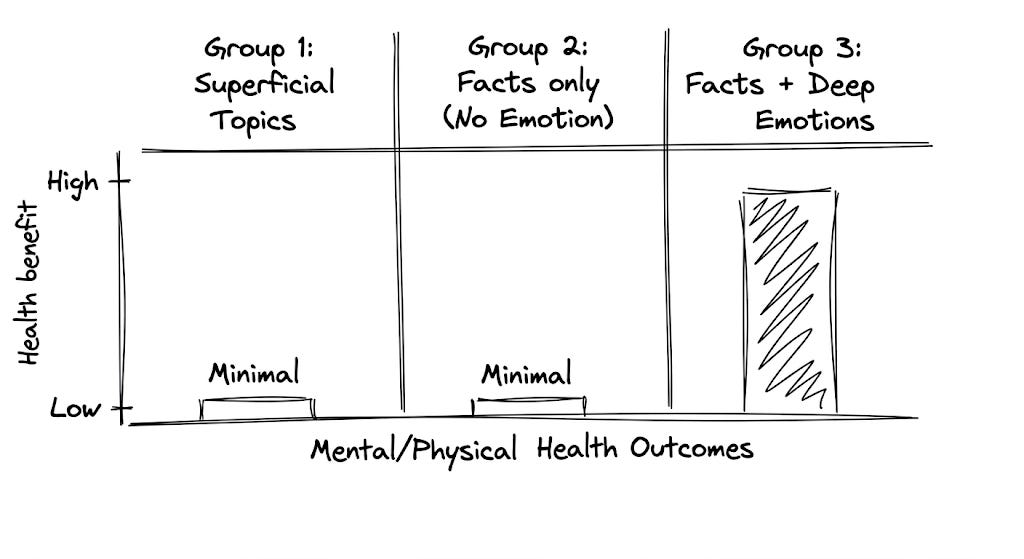
In 1986, psychologists James Pennebaker and Sandra Beall ran one of the most replicated experiments in psychological research at Southern Methodist University. They split healthy undergraduate students into three groups and had each group write for 15 minutes a day across four consecutive days.
The first group wrote about boring topics like describing their dorm room, their shoes, or a tree outside the window. Pure surface-level observation with no emotional content whatsoever.
The second group wrote about a traumatic or stressful event from their lives, but with strict instructions: facts only, with no mention of how it felt or what it meant.
The third group wrote about both the facts and their deepest thoughts and feelings about the experience, the reasoning behind what happened, the emotional weight of it, and what it meant to them.
What the Data Showed
The differences in long-term physical and mental health outcomes across the three groups were significant. The first two groups showed minimal lasting benefit. The third group showed measurably better health outcomes months later.
Writing that forces you to process your reasoning and emotions is what produces the effect.
You already know this distinction at work. A log entry that says “pipeline failed” is useless, but a post-mortem that captures what failed, why it failed, what assumptions were wrong, and what you would change is what actually improves the system.
The same principle applies to you.
At the senior level, the events worth processing are rarely technical. Instead, they are the messy, ambiguous, political moments that shape how you lead.
Writing about what happened is the easy part. But writing about why you made the call you made, what you were afraid of, and what you would do differently is where the actual learning happens.
How to Write
The blank page is where most people quit. The habit dies before it starts because writing “whatever comes to mind“ produces nothing useful and feels like a waste of time.
Proper structure fixes this. A small set of questions you return to consistently is all you need.
The Weekly Review
Once a week, write about three things:
A decision you made and the reasoning behind it
Something that frustrated you and what you think is underneath it
Where you are relative to where you want to be
You need fifteen minutes at most. The goal is to get your thinking out of your head and into a place where you can actually look at it.
This is the layer that catches the things you would otherwise carry forward unresolved. Most engineers have three to five open loops in their head at any given time, a conversation that did not land, a call they second-guess, a relationship they are unsure about.
The weekly review is where those loops get closed, or at least named. Named problems are manageable, while unnamed ones accumulate.
The question that does the most work is the second one. Frustration points at something you care about, something that conflicts with how you think things should work, or something you have been avoiding. Writing about what is underneath it is where the actual insight lives.
The Event Log
Whenever something significant happens, write about it the same day. A hard conversation, a project that went sideways, a moment where you handled something better than you expected.
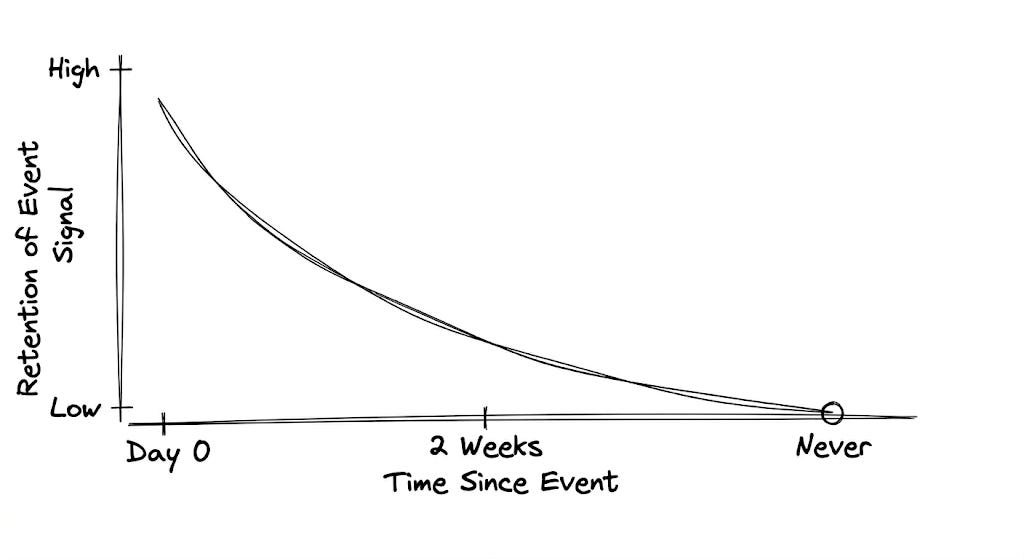
The detail fades faster than you think, and the reasoning fades even faster.
Two weeks after a difficult stakeholder conversation, you will remember the outcome but lose the texture of what you were thinking, what you were afraid of, and what you chose to say versus what you held back. That texture makes the entry useful when you read it six months later.
The event log is also where you catch your own patterns before they become problems. The same frustration appearing three times in four weeks is information. The same type of conversation going badly repeatedly is a skill gap worth addressing. It’s very hard to see any of that without a record.
The Career Retro
Once a quarter, zoom out. What did you ship, what did you avoid, where did you grow, where did you stall. This is the layer that makes the weekly entries useful because patterns only become visible when you read across time.
The career retro is the closest thing to running a proper retrospective on yourself. Most engineers run retros on their projects and never on their own trajectory. A quarterly review of your own writing surfaces the things your brain was too close to see in the moment.
Read back through the last three months of entries before you write the retro. Look for recurring themes, recurring frustrations, recurring avoidance. The goal is to walk away with one or two things you want to do differently in the next quarter, leaving the long list of resolutions behind.
Write Like You Talk
Specificity beats polish every time. What happened, what you decided, why you made that call, what you would do differently. You are creating a record your future self can actually use, and that record is only useful if it is honest.
The trap most people fall into is writing for an imaginary audience. They tidy up their reasoning, smooth out the contradictions, and produce something that reads well but captures nothing real.
The entry that says “I approved the hire because I was under pressure and did not do the reference check properly“ is worth ten times more than one that says “we moved quickly on this one“.
Dictation changed how I write entirely. I dictate most of my entries now (the same way do with this article). Speaking removes the friction of the blank page and keeps the tone honest. You do not perform for a voice memo the way you perform for a text editor. The words come out closer to how you actually think.
Start Slow
Write when you have something to write about. The weekly review, the event log, the quarterly retro are all things you build toward, not things you set up on day one. Pick one thing that happened this week and write about it for ten minutes. That is the whole system for now.
The mistake most people make is treating the habit like a project. You design the perfect framework, pick the perfect tool, and quit two weeks later because the system is too heavy to maintain.
The habit comes first. The system comes later, once you know what you actually need.
And here’s one more principle to mention: Consistency over completeness. A messy entry you actually wrote beats a perfect template you opened and closed. The value builds through repetition, and repetition only happens when the bar to start is low enough that you do it even on the days you do not feel like it.
With time, when you start enjoying it (because you will), set a system. I wrote about that on the Dear Self blog.
Why Email and AI Changed Everything
Paper journals have a beautiful aesthetic and a fatal flaw. You cannot search what you wrote. The insight you wrote down eighteen months ago stays buried unless you happen to find the right book and flip to the right page.
A writing practice that compounds over time only works if you can surface what you wrote.
Most apps solve the search problem but introduce a different one. They add friction by locking your data into a format you do not control, and they tend to disappear or pivot into something you never asked for. You have probably abandoned at least one app and lost everything inside it.
Why Bullet Journaling Eventually Breaks Down
Bullet journaling worked well for me for years. The structure kept the habit alive and the format was fast enough to not feel like a chore.
However, Bullet journaling is optimised for capture, and capture alone produces the same result as the second group in Pennebaker’s experiment. You get the facts and skip the reflection. The entries become a log of events rather than a record of your thinking, and a log of events without reasoning is not much more useful than a calendar.

Why Email Works
Email is the one tool you will never abandon and never lose access to. There is no new interface to learn, no blank page anxiety, and no proprietary format trapping your entries. You open a compose window, write, and send it to yourself. The archive is searchable from day one.
Writing to yourself by email also changes the tone in a useful way. You are writing a message to your future self, and that framing naturally produces the kind of specificity and honesty that makes entries worth reading later.
It is close enough to a conversation that the words come out more naturally than they do in a dedicated journaling app.
Where AI Changes the Game
Search is the foundation, but AI is what turns a collection of entries into a system that actively works for you.
The difference is between a graveyard of notes and something that talks back:
Proactive prompts surface the questions worth asking based on what you have already written.
Reflections get surfaced back to you at the right moment, connecting something you wrote six months ago to something you are dealing with today.
Patterns you would never spot manually become visible across hundreds of entries.
This is the layer that makes the whole practice qualitatively different from anything that existed five years ago. The ability to query valuable writing, reflect on it, and have it reflected back to you is what makes it a system.
That is why I built Dear Self.
I actually built it for myself, and after a few months I can say it is the best journaling experience I have ever had. I want to share that with you. It is free and if you are a paid Data Gibberish subscriber, DM me and I will get you your first year of premium features on me.
Final Thoughts
The best engineers I know learn faster than everyone else, because they are better at extracting signal from their own experience.
You have been generating that signal for years. Every hard decision, every difficult conversation, every project that went sideways and every one that worked better than expected, contains information about how you think, where you are strong, and where you have room to grow.
Writing is how you stop letting that information evaporate.
The engineers who compound fastest are the ones who treat their own career with the same rigour they bring to their systems. They log, they retro, they reflect. They build a record of their own reasoning and they actually use it.
You already know how to do this work. You do it every day for your team, your stakeholders, your infrastructure. The only thing left is to point the same discipline at yourself.
Start this week with one entry in less than ten minutes. Write about something that is still sitting in your head from the past few days and what you actually think about it.
That is the whole system for now.
—
Yordan
PS: The medium doesn’t matter and you don’t need to use my service. But if you do, I’d love to hear your constructive feedback. Start by writing an email to me@dearself.ai.