


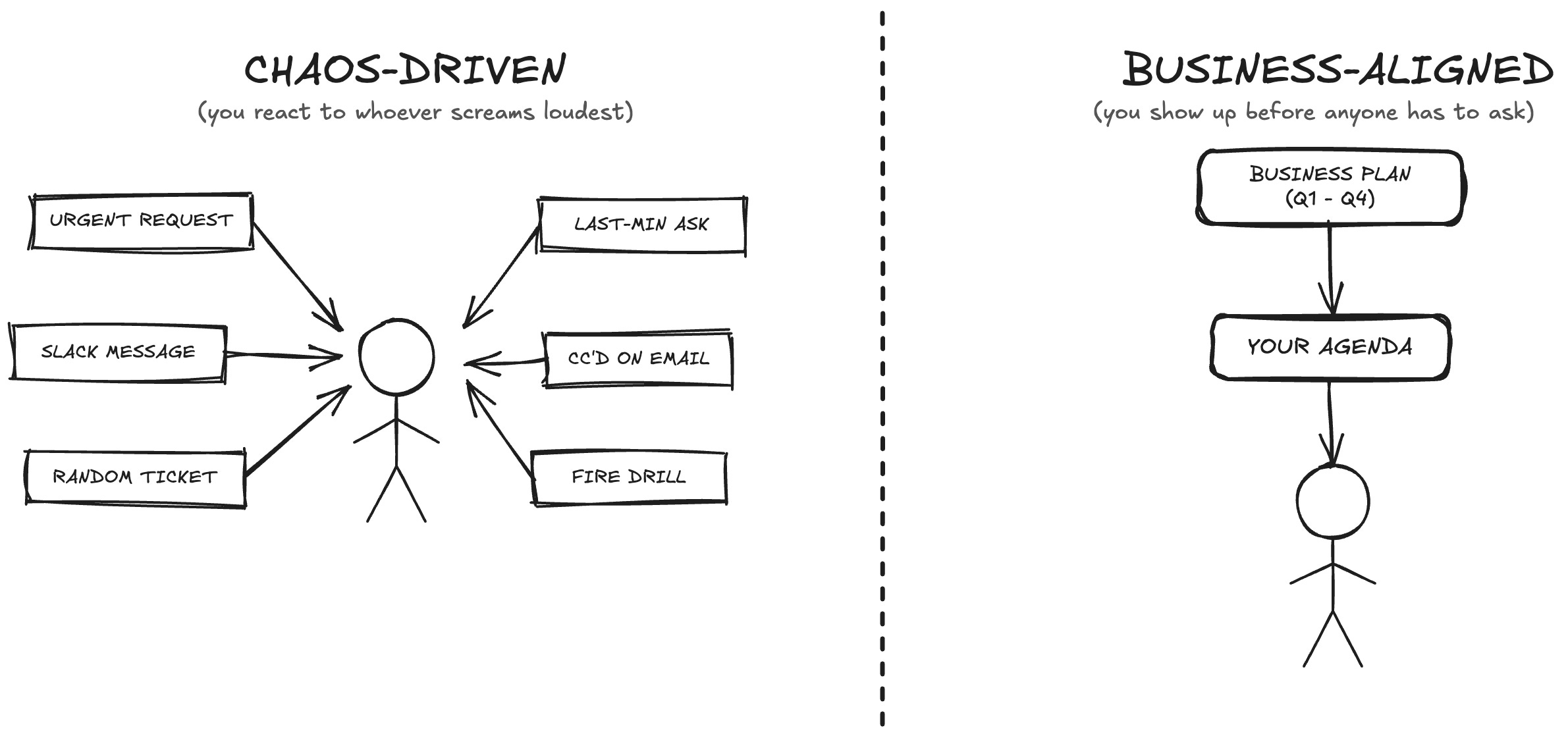
Finance Year 2027 at my company starts in May. I always know company’s plans upfront. I thought FY26 was the same. By Q2 everything had shifted and what we called a roadmap was just a wishlist.
My team complained and I decided to change my tactic.
This year I grabbed my CPTO. Before any announcements, before any all-hands, before the business had even finalized anything. I asked what was coming, so I can take my team’s wishlist and map it against the company roadmap. That way we can build a plan that was realistic and OKRs we can actually hit.
The difference between a team that spends the year firefighting and a team that spends it delivering is just one conversation.
Every surprise project, urgent pivot, and “nobody told us” moment are your damn fault. That’s a business alignment problem, and it starts with you. Here’s what I mean.
The Drama Is the Point
There is a version of you that secretly enjoys the chaos. Think about it: The urgent Slack at 11pm, the all-hands pivot that wrecks your sprint, and he stakeholder who drops a critical request with a two-day deadline. You complain about all of it, and then you solve it anyway. And for a moment, you feel indispensable.
Reactivity performs well in the short term.
You look responsive, like someone who gets things done under pressure. Your manager sees you handling fires and assumes you’re good at your job. What they don’t see is that you lit half those fires yourself by skipping the data team planning conversations that would have changed everything.
The senior engineer who thrives in chaos is someone who never learned that prevention is harder to see but worth ten times more. Heroes get celebrated, so you keep choosing the version of the job that gets you noticed, even if it’s burning your team out.
Here’s what that costs you. Every urgent pivot your team absorbs without warning is two weeks of actual work gone. Retooling, re-scoping, re-explaining priorities to people who had different priorities yesterday.
Nobody tracks that cost. It just disappears into your team’s capacity and you fall behind on everything else.
Nobody Tells Anyone Anything
Here is the excuse I hear most:
The business doesn’t communicate with us. We find out about things last minute. We’re not in the meeting when decisions are made.
I’ve said versions of this myself. It’s true, but it’s also irrelevant.
PMs find out about things late. Finance gets surprised by headcount freezes. Sales hears about product changes from customers before internal announcements. Nobody in a fast-moving company has perfect information.
The difference is some functions treat that as a reason to push harder for clarity, and data teams treat it as a reason to complain.
Nobody owes you a seat at the planning table. Stakeholder alignment is not a gift. You earn it by showing up before the table is set. That means walking over to the PMs in April and asking what Q3 looks like.
It means grabbing your CPO before the roadmap is finalized and asking what bets the business is making. It means having those conversations when nothing is urgent, so you’re not having them when everything is.
The business will always move faster than it communicates. That is how companies work. Your job is to close that gap yourself, and not wait for someone to close it for you.
Every team that gets blindsided had months of opportunity to ask. But they didn’t, and when the surprise landed, they opened Slack and started typing about how chaotic everything is.
That’s your fucking choice. Own it!
Alignment Is Just a Conversation
I think data people overcomplicate this. They hear “alignment” and picture a formal process:
A recurring meeting with an agenda.
A shared OKR document that everyone updates religiously.
A stakeholder map with color-coded relationship scores.
None of that is what I’m talking about.
Alignment is you walking over to your PM and asking “what’s keeping you up at night for the next quarter?”. That’s it. That’s the whole thing.
All you need is ten minutes and the willingness to ask a direct question before the pressure is on. Most data people never do it because it feels uncomfortable to show up without a specific ask.
But you’re not there to solve anything yet. You’re there to listen. That feels unproductive until the moment it saves your team three weeks of rework.
Do it early enough and you find out about the product release that was going to wreck your pipeline before it wrecks your pipeline. You find out the business is doubling down on a market segment your data model doesn’t support yet.
None of that information was secret and nobody was hiding it from you. But you never bothered to ask.
One business alignment conversation in March is worth more than any amount of sprint planning in September. By September the decisions are made, the timelines are set, and your team is already behind. In March you still have room to shape what’s coming.
Ask.
Final Thoughts
There is a ceiling reactive data professionals hit and never understand. They execute well, handle pressure, and solve hard problems fast. But they stay exactly where they are for years.
Because nobody above them sees a leader. They see someone who is very good at cleaning up messes.
The career cost is not the missed deadlines or burnt out team. It’s that you built a reputation for surviving chaos instead of preventing it. And that reputation follows you.
The people who move up are the ones who made their team predictable. The one who walked into planning conversations early. Those who stopped being surprised because they stopped waiting.
Every year you spend firefighting is a year you didn’t spend building that. Reputation compounds. The person known for calm, prepared delivery gets pulled into bigger problems. The person known for handling chaos gets handed more chaos.
You get to decide which one you are. But you have to decide in March, not in September when everything is already on fire.
Until next time,
Yordan
PS: Want to earn trust, respect and bigger budget for you and your data team? I have all the right playbooks in Premium Content Library.
Good article.
Your 'Business-Aligned Plan' approach is courageous and advantageous. The worst thing the client can say is, "This is not correct." And (s)he will need to then present you with the accurate and comprehensive plan and the formal strategy.
If they say they don't yet have a biz plan and/or strategy, then you just took the first steps to leading that effort. and demonstrating your credibility.
I agree with you. In my experience, the first several month in my first job was filled with chaos and firefights. After I became friends with the Senior Project Manager and Data Scientists, things suddenly became controllable. I also like spreading such strategy information to my team rather than hiding it in my mind.