


This article is part of the Lead & Grow playlist. Click here to explore the full series.

If you wait for a calendar invite or a HR-mandated form to tell you you’re ready for the next level, you’ve already failed the test for that level. You essentially ask your manager to be your career coach, your biographer, and your cheerleader.
Most data professionals treat their career growth like a ticket in a Jira quee. They ship the code, they hit the KPIs, and then they wait for the status to change to “Promoted”. They think their manager is “too busy” or “forgetful”.
The truth is harsher. You made yourself easy to ignore because you waited for a permission slip to grow.
The First Move: Stop Asking for a Review
The biggest mistake you can make is to ask for a “performance review” when no process exists. You ask for a meeting that your manager doesn’t know how to run and doesn’t want to organize.
Shift your focus from the review to the requirements. Book a one-to-one and ask this:
What do you expect a person on my level to be able to do? What can I do more to contribute more to the org?
The framing here is everything. You aren’t a kid who asks for more toys, but a mature professional who cares about the wellbeing of the company. You identify the gap between where you are and where the company needs you to be.
During this conversation, push for specifics. If they say “be more strategic”, they’ve given you nothing. Ask for specific projects or behaviors. The more concrete the requirement, the harder it is for them to move the goalposts later.
But remember: doing a task once isn’t a skill. It’s a chore. If you’re told to “lead more meetings”, and you lead one meeting, you haven’t leveled up. You’ve just checked a box. You must show a permanent change in quality.
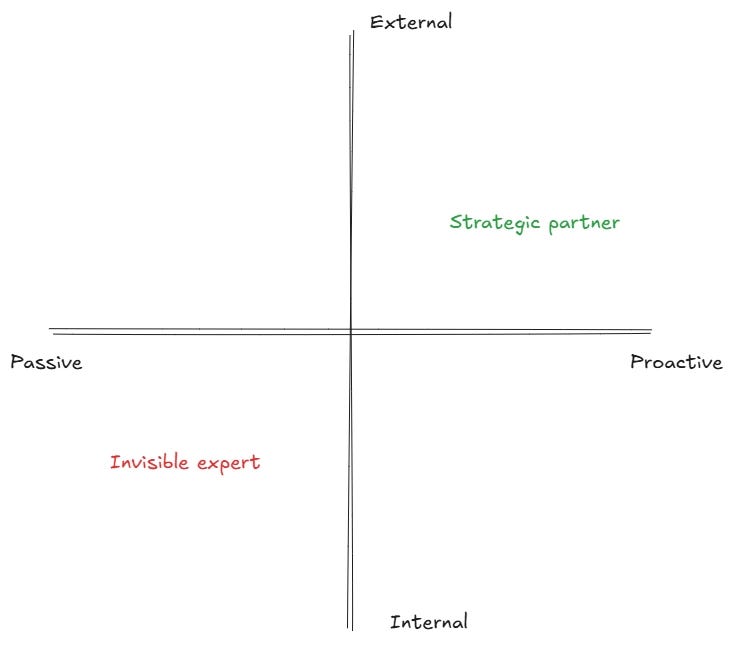
The difference between being overlooked and being promoted is usually just a change in who owns the growth path.
The Engine: The Brag Document
Your manager’s memory is a leaky bucket. They don’t remember that you saved the Q3 reporting cycle by fixing a legacy pipeline in your sleepm but will remember that you missed one deadline in November.
This is why you need a Brag Document.
A brag document is a live log file of your professional judgment, not a CV. If it’s not logged, it didn’t happen. Follow the gold standard here:
Track every achievement, every decision, and every win in real-time. Focus on outcomes rather than tasks.
Don’t just write “Organized the data dictionary”. Instead, write “Organized the data dictionary, which reduced onboarding time for new analysts from three weeks to one”.
Include the things that don’t show up in a GitHub commit:
Exercised judgment by saying “no” to a low-impact request.
Organized a cross-functional meeting that aligned three teams on a single metric.
Spent ten hours mentoring a junior engineer who now owns the ingestion layer.
These are the markers of a senior professional. If you don’t track them, you are relying on your manager’s memory to decide your salary. That is a dangerous gamble.
How Walt Won a 17% Raise
A coaching client, Walt, worked at a scale-up with zero formal reviews. For two years, he was the “reliable guy”. He shipped everything on time, but his salary stayed flat while the market moved.
Walt stopped waiting.
He started by benchmarking his role against the external market to see exactly how underpaid he was. Then, he built a brag document that mapped his daily output to the business value he created.
Instead of going to to his manager with the phrase “I feel I deserve a raise”, Walt went with evidence. He showed the benchmarking data, the brag list, and the links to his achievements directly to the requirements he had agreed upon six months prior.
Walt, built a business case rather than an emotional plea.
In result, Walt got a promotion and a 17% increase in total compensation. The evidence made the cost of losing Walt higher than the cost of promoting him.
Closing the Gap
Once you have the requirements and the evidence, you have to close the loop.
Do not wait for the end of the year. Book the conversation 3-6 months before you expect a change. Use your existing weekly one-to-ones to keep the momentum going.
The script is simple:
Remember how I asked you what I need to deliver to start working on the next level? I believe I’ve learned what you told me. For example, I did X and Y. I can send you my full achievement list after this call. Let’s talk about my promotion.
Your manager might get defensive. They might say “not yet”.
Do not get angry. Anger is a junior response. Maturity is the only currency that matters here.
Take the “no” as a diagnostic tool. Ask for clarity:
What exactly is missing? What is the specific gap between my current output and the next level?
Exit the discussion with clear action points. Even if the action point is “we will define the exact criteria in our next call”, you have won. You have moved the conversation from “maybe” to “how”.
Final Thoughts
If you are like most engineers, you always wait for clear career path provided by the org they work for.
The reality is that you are the only owner of your career.
If you wait for a clear career path provided by your organization, you are making a bet that your manager’s agenda perfectly aligns with your financial and professional growth, but it rarely does. Your manager is focused on their own KPIs, their own stress, and the immediate fires in the pipeline. When you leave your growth in their hands, you are leaving money on the table.
This risk is higher now than it has ever been.
AI changes everything and nobody knows what our career will looks in 20 years from today. Heck, we don’t know what it would look like in 5 years. The technical skills that got you pronoted three years ago are becoming commodities, and the only hedge against this volatility is ownership.
The organization will never provide a map that is more accurate than the one you build yourself through evidence and negotiation. So, stop asking for permission to grow, and start owning the evidence, defining the requirements, and driving the conversation.
If you aren’t the one managing your career, someone else is. And they are almost certainly underpricing you.
That’s why I created this complete guide and worksheet for paid Data Gibberish subscribers to help you fast track your promotion and get paid what you really deserve.
—
Until next time,
Yordan
PS: Next time we’ll continue and I will show you how to frame your wins in a business case that gives your manager no choice, but to promote you.
PPS: Many readers prefer to get help with implementing the ideas I share here and be get better results faster. That’s when they come to me for coaching. Book your free call now.