



When an executive asks you a question on a call, you feel the stress in the back of your neck, especially when they ask you about things you really don’t know.
You feel the stress of all eyes looking at you. You are the expert, and you must have the answer. You are either an expert or a fraud. So, you have no other choice but to say what you know, and build your theory based on that. You guess, while trying to look confident.
I know this about you because I was doing the same.
With a CFO, with VPs, and with founders, I did it all the time, and it was worst at the start, when I’d just begun talking to executives and had no manager on the call to represent me.
If you’re doing a lead’s job without the title, those calls are already yours, with nobody more senior on them to take the hard question off you.
I covered how to give updates business people understand. This one goes after the guess, because whether to guess was never my decision to make, and it isn’t yours either.
Nobody on the call asked you to guess
The people asking would rather you paused than guessed, and I only found that out when some of them asked me to.
You believe that you, as the expert, need to have the answer on the spot, and that every second of silence counts against you. You are either good or mediocre.
I believed it too, so a pause felt like a verdict and a confident guess felt a hell of a lot cheaper than sitting through one. Then the manager I had at the time taught me to say only what I know, and that it’s fine to say this:
I don’t know yet, but I will check and come back to you with an answer.
Later, I learned that people don’t see this approach as mediocrity, but as care.
The topic of the next Show & Tell session is estimations, or how to give educated guesses about the length of your future projects. I will show you my estimation approach and you’ll get my task management project with all the formulas to copy.
A guess is a judgement you say as a fact
Every guess I made on those calls started as a judgement, and I said it as a fact.
My philosophy is that people need to be able to trust me, always, because trust is what lets you lead people, title or no title. If I say something’s white, they know it’s white, and they don’t need to check it.
A confident guess is a lie, even when the number turns out right.
When the number turns out right, you still told them you knew it, and you didn’t.
The strongest case against me comes from Sean Goedecke, who writes that
Many engineers either feel that it’s dishonest, or lack the courage to commit to claims where they’re only 80% or 90% confident.
He’d put me in the first group, and he’d point to his own experience that “managers are very forgiving when you make a technical call and it ends up being incorrect“.
A decision is yours to make with partial information, and Democracy Is Overrated is my whole argument for making it, but a fact is never yours to invent. When the CFO asks why your revenue number doesn’t match finance’s, the answer exists somewhere, so anything you say as a fact before you’ve found it is a guess.
Guessing works until someone can check
You keep guessing because most of the time it works, and it works because nobody on the call can check your number while you’re still talking.
Kevin Goldsmith says what happens next
If you guess and you’re wrong, the next time they hear about your project from someone with the real information, they’ll wonder whether you were confused or covering something up.
When they check, your next number gets discounted, and so does whatever you’re asking for with it. Your budget request gets its figures checked before anyone listens to your argument, which is a shit trade for one confident sentence you didn’t need to say.
I ran that risk on nearly every call at the start, when I was guessing all the time.
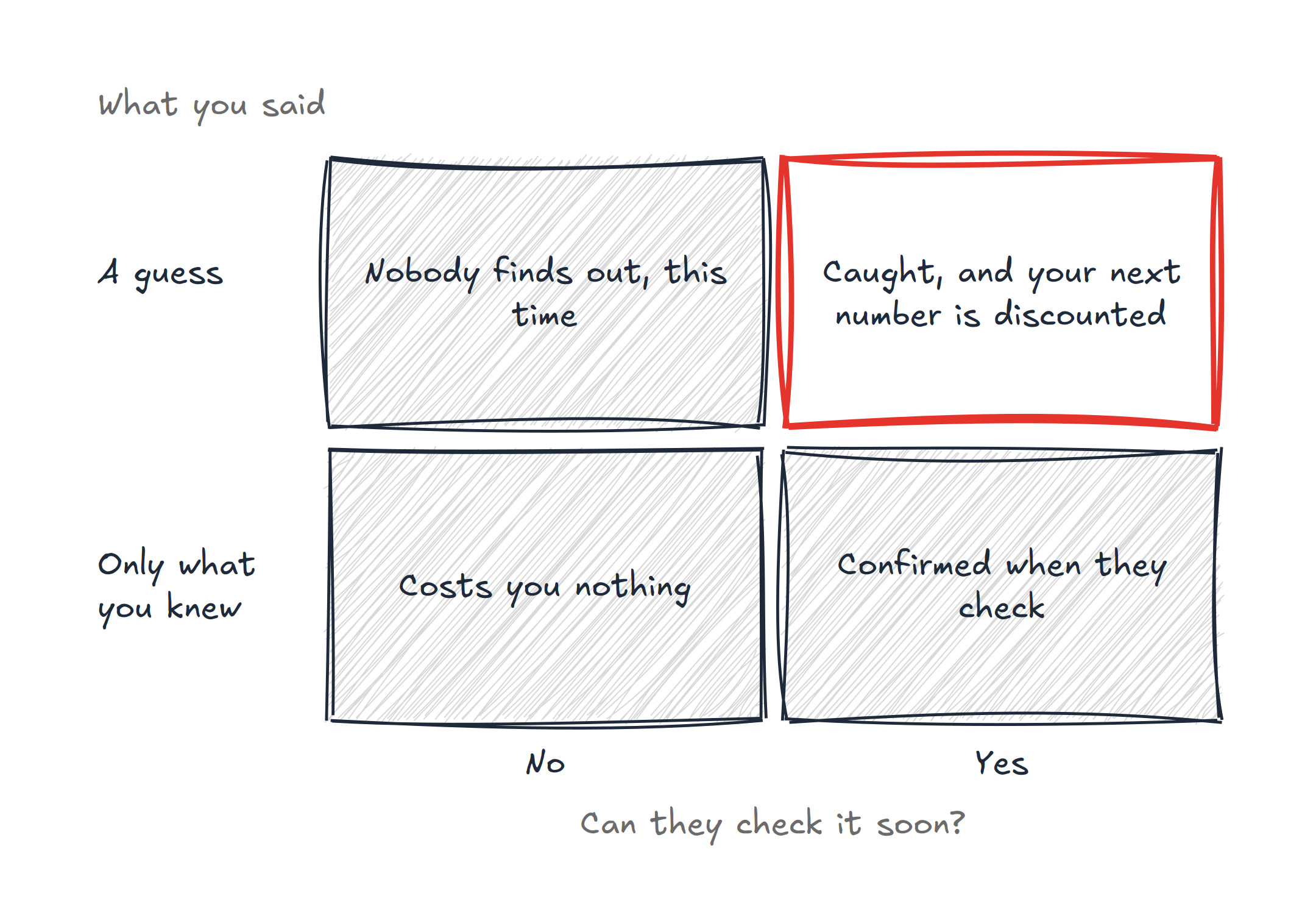
Say only what you know, and a range counts only if you had it before they asked
My rule is “only say what you know, and if you have a range, go with it“.
Your range counts as something you know when you have it before the question. If you size the migration before the call and it comes out as a range, that range is a fact about your work, and you give it with what it rests on. A range you put together on the call while everyone waits is a guess with a wider margin, and they hear it as a number all the same.
The same goes for your team’s estimates, and I know mine, so when an executive asks for one, I give it and what it rests on, like any other fact about our work.
So you answer in three lines, in one breath:
What I know
What I don’t know yet
When you’ll have the rest
The third line is what buys you the pause, because the senior managers who asked me to pause also asked me to tell them later.
If they want an estimate, they’ll ask for one
When an executive insists on a rough number on a call, give one, call it an estimate, and say what it’s based on, and when nobody asks, don’t volunteer one.
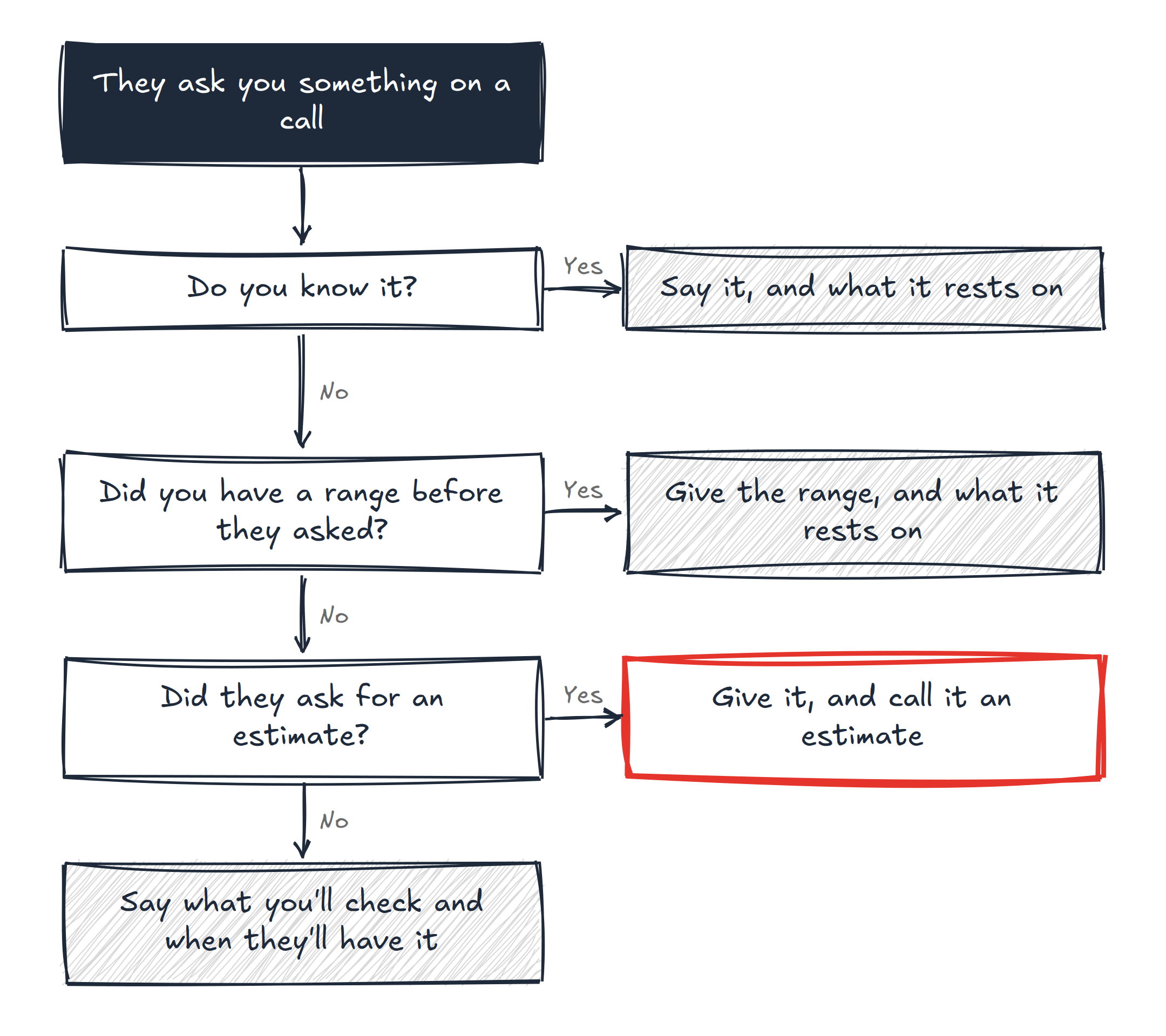
That rule decides for me, since whether a rough number is useful is your executive’s call. If they need one, they’ll tell you, which frees you up to answer the question you can answer.
An estimate is theirs to ask for.
A guess you volunteer gets heard as a fact, because you said it as one, and an estimate they asked for gets heard as an estimate, because they asked for one. You can say the same number both times, and they weigh it differently depending on who decided it was needed.
If finance or another team owns part of it, say when you’ll have that part, and give the rough version only if they tell you rough is fine.
When you rattle off technical detail nobody asked for, you’re making the same mistake with more words, and my piece on giving updates business people understand covers how to put the decision before the detail.
For your own case, the ready-to-use version is my digital twin, and it comes with the annual subscription.
