


This article is part of the Land Your Next Role playlist. Click here to explore the full series.

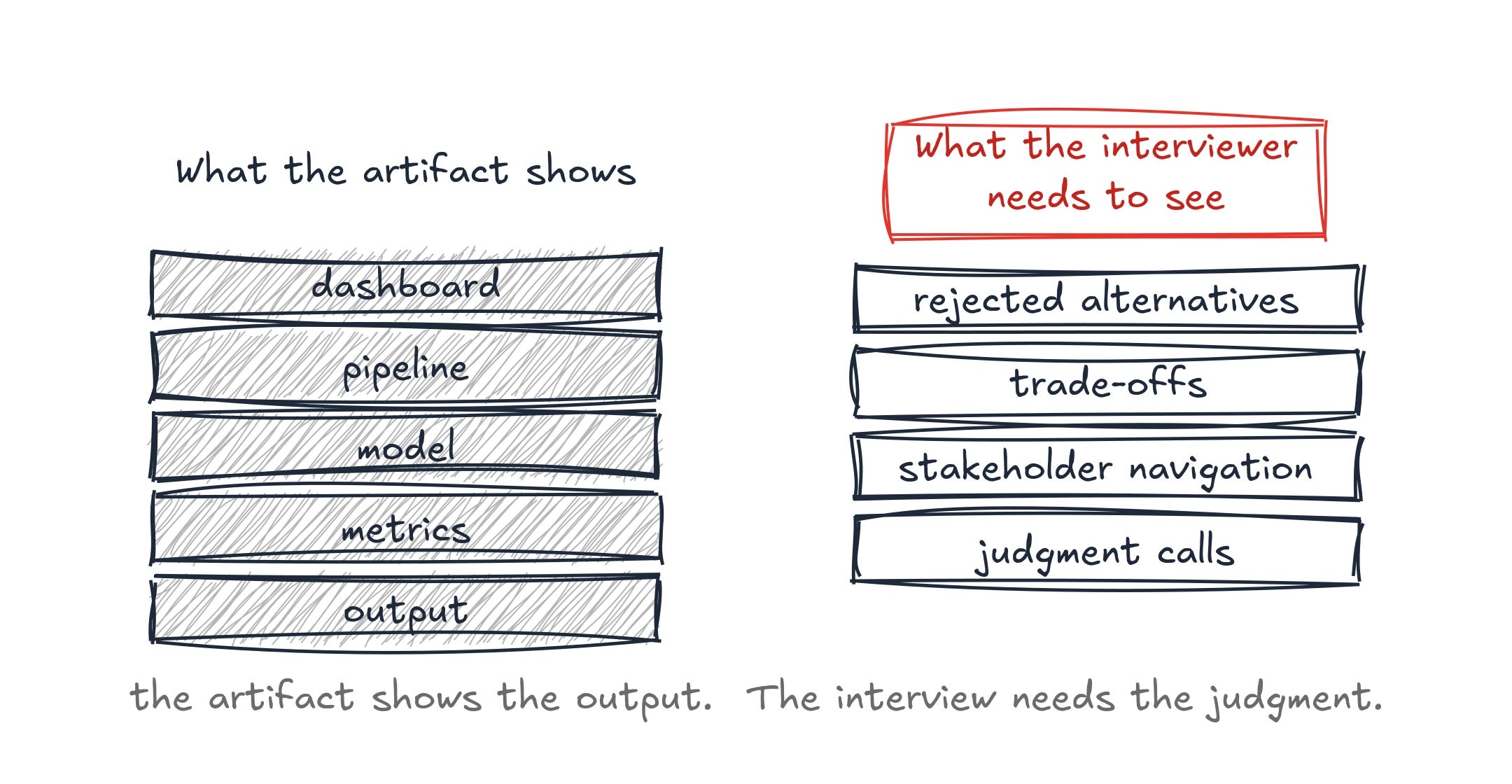
When you interview, the polished artifact does the talking. A dashboard shows the output. It hides the actual work:
the trade-offs
the rejected alternatives
the stakeholder you talked out of a bad idea
That hidden part is what the interviewer is trying to assess, and you never articulate it because nobody ever asks you to.
You don’t hide it on purpose. You build the thing, so the decisions feel obvious to you. The interviewer sees only the result and has to reverse-engineer the reasoning from a screenshot. Most of the time they give up and ask you to walk through the code. That tests your memory. It tells them nothing about your judgment.
The Resume Is a Weak Signal
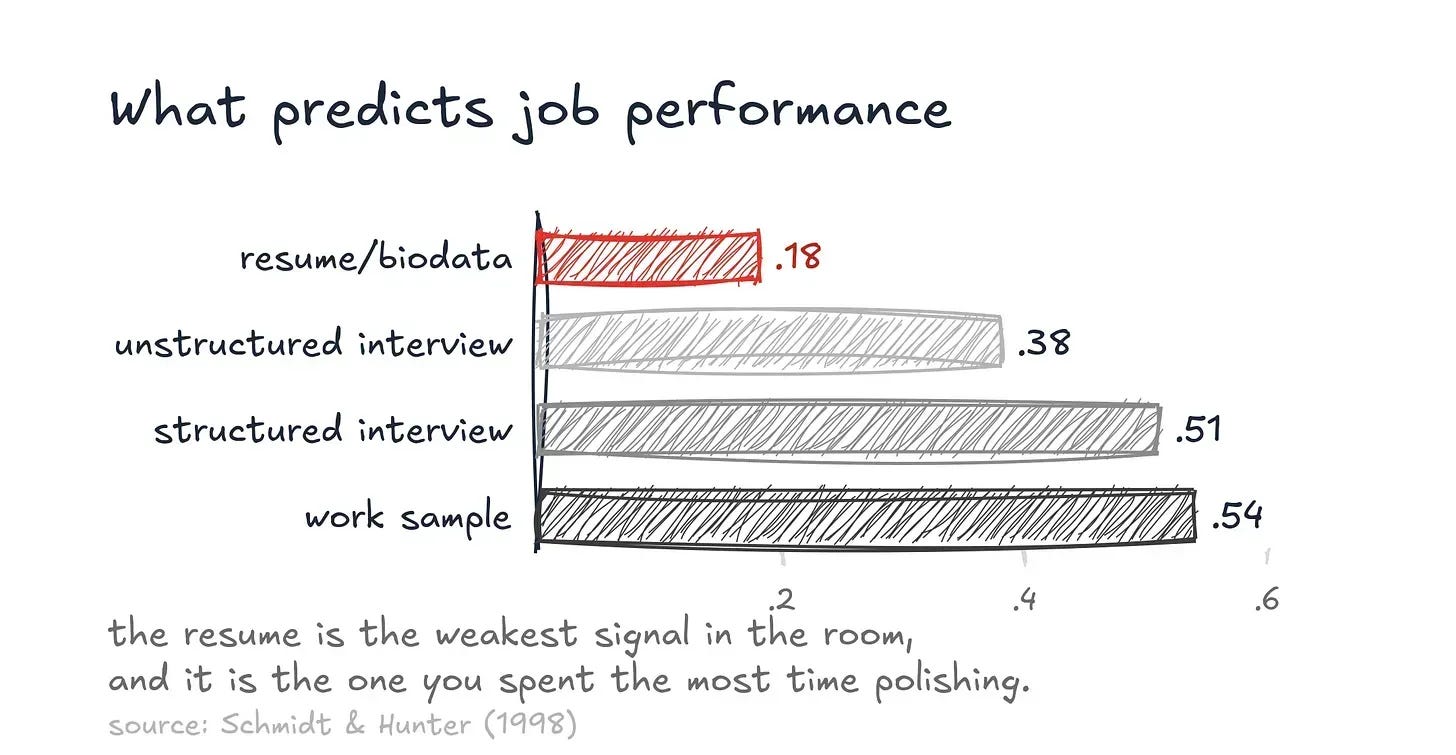
Schmidt and Hunter's 1998 meta-analysis puts the correlation between resume content and job performance at .18. That is barely above noise, and it stays true twenty-eight years later. The 2022 revision by Sackett and his co-authors pushes the numbers down further. The resume is the weakest signal. It's also the one you spend the most time polishing.
The Interview Rewards Confidence
The interview format rewards confidence. Confidence is not judgment. The candidate who says “I built this, it’s great, here are the numbers“ sounds better than the candidate who says “I built this, I rejected three approaches first, and I’m still not sure the fourth is right“. The second candidate is showing you judgment. The first is showing you a highlight reel. The format rewards the highligght reel, which is bullshit, because it’s the one thing that doesn’t predict the judgment the job actually needs.
Even the work sample, the thing everyone agrees is the strongest predictor, is weaker than we think. Roth and his co-authors revise the validity of work sample tests from .54 down to .33 in 2005. A polished portfolio project is a work sample that tests output. It never touches judgment.
Internal Promotions Are Worse
The internal promotion interview is worse. When you interview externally, the interviewer tries to figure out your judgment and mostly fails. Internally, the interviewer already knows you. The decision happens in meetings you’re never in, based on what people decided about you months ago. The interview just makes it official.
Benson, Li, and Shue find in 2018 that doubling a salesperson’s pre-promotion performance predicts a 7.5% decline in their subordinates’ performance after promotion. Companies promote on the skills that make someone good at the current job. Those are different from the skills the next job needs. For data people, that means you promote on pipeline qualityand model accuracy. Then you act surprised when the new lead can’t handle a stakeholder.
I sit on both sides of this. I hire people whose portfolios look great. Their judgment turns out to be thin. I also watch good people lose interviews because they can’t articulate the judgment that’s obvious in their work. I’ve been that person too.
You’ve Been Running on Vibes
You can’t explain why you reject three alternatives in an interview because you never write it down when you reject them. And you never write it down because, if you’re honest, you don’t reject them for reasons. The first approach feels wrong and the second feels slow, so you pick the third and call it judgment.
The decision log is a mirror. When you sit down to write “I rejected X because Y“ and you can’t fill in Y, you learn something about how you actually make decisions. You’ve been running on vibes your whole career and nobody ever made you write it down. That’s a shit realization, but it’s better than having it in an interview.
Make the Judgment Visible
Put the judgment in the artifact itself. Write the decision log. Next to every dashboard or pipeline you ship, write down:
the three alternatives you reject and why
the stakeholder who wants the wrong thing and what you say to them
the trade-off you make and what it costs Five lines is all it takes. I do this all the time. This is what helped me move from data engineer to head of data engineering in less than four years.
When you interview, walk through the rejected alternatives. Leave the final output for the end. “I could do X, but I choose Y because Z“ tells the interviewer more about your judgment than the dashboard ever will. It also gives them something to probe.
Your judgment stays invisible unless you write it down. Nobody else will do it for yo.
The Decision Log Workbook
I turned the five lines into a workbook so you don’t have to figure out the format yourself. It has the template, a filled example, and ten questions that force the reasoning out when your answer is “it felt wrong“. There’s also a script for walking through the log in an interview, and a version for the promotion interview.
I turned the five lines into a workbook so you don't have to figure out the format yourself. It has the template, a filled example, and ten questions that force the reasoning out when your answer is "it felt wrong". There's also a script for walking through the log in an interview, and a version for the promotion interview.
Upgrade now get my toolkit and start presenting your work in a way that pays more.
Final Thoughts
The skills you’re proud of, writing code and architecting platforms, stopped being advantages the moment AI could do them. In 2026, leaning on them is running on fumes. AI can’t decide. Deciding is the one thing you’ve never practiced.
AI makes the resume even weaker. A Robert Half survey of more than 2,000 hiring managers in late 2025 finds that 65% say AI-generated resumes make skills harder to verify. If you write it with a robot, it reads like everyone else’s. Your judgment is the only thing that could set you apart. It’s still in your head.
I talk to tech professionals in my coaching practice, and they all make the same mistake. The ones who spent years honing their technical expertise never get promoted. You put your head down and work withot looking around. You have no idea what your impact is, and you don’t know how much your expertise costs. You leave money on the table.
I’ve helped many of them overcome this, so I’m working on something for everyone, and I’ll announce it very soon.
—
Until next time,
Yordan
PS: This applies to the promotion interview too. The people who decide already watch you build the thing. They never see why you build it that way. Write that down before you walk in.
PPS: I help tech nerds getting paid what they really deserve. Book your free discovery call today, if you are ready to earn real money.