


This article is part of the Build & Lead Data Teams playlist. Click here to explore the full series.
Someone once asked me where their data team should sit. R&D, Finance, or somewhere else. They expected a clean answer. What they got a train of thoughts.
I’d seen this org hire a strong data scientist. Smart. Curious. Good instincts. The insights were solid. Leadership still hated it.
Why does it take so long?
Why do numbers keep changing?
Why can’t anyone else see how this works?
The problem wasn’t the data scientist. It was the bet the company made without realizing it.
By putting data in a specific department, they had already decided what kind of truth they cared about, who would defend it, and which complaints would win when priorities collided.
That’s the part most teams miss.
Where your data team sits isn’t an org-chart detail. It’s a strategic decision about influence, incentives, and authority. And once you see it that way, the tradeoffs become obvious.
Putting Data in a Department Is an Incentive Design Choice
Most leaders think they’re making a reporting decision. They’re not. They’re designing incentives, whether they realize it or not.
Where data sits determines who feels entitled to its time and who feels ownership over its output. It decides which questions are considered legitimate, which metrics get protected, and which disagreements escalate to executives.
This is why data teams don’t gain influence by being technically correct. They gain influence by being defended. The department you sit in defines who backs you when two priorities collide and both claim to be urgent.
That backing shows up in small ways that compound. Which projects survive reprioritization. Which metrics are allowed to change. Which complaints get reframed as “noise” and which turn into action items.
There is no neutral placement. Every reporting line comes with a default customer, a default definition of value, and a default escalation path. Even independence is a choice with its own incentives and risks.
Once you see placement this way, the question stops being “where should data live?” It becomes “what tradeoffs are we intentionally accepting right now?”
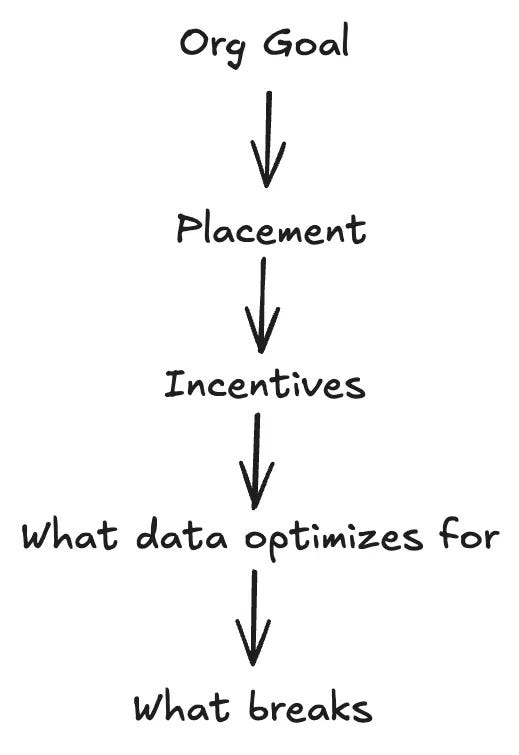
When Data Sits in Finance, You Optimize for Financial Truth
When leadership puts data in Finance, they are usually trying to answer one question: do we actually understand how the business makes money.
This shows up early in companies that are growing fast but don’t trust their numbers. ARR means different things in different decks. Forecasts change depending on who presents them. Nobody is fully confident explaining why last quarter moved the way it did.
A finance-backed data team exists to remove that ambiguity. Its primary job is to make financial reality legible, defensible, and repeatable. Consistency matters more than novelty. Historical stability matters more than speed.
In this setup, metric definitions harden quickly. Once something is agreed on, it is expected to stay agreed on. Changes are slow, explicit, and often painful. That’s a feature, not a bug.
The tradeoff is that product curiosity takes a back seat. Exploratory analysis feels expensive. Reworking logic to better reflect user behavior is often perceived as risk, because it can destabilize numbers executives already rely on.
This is why finance-embedded data teams often feel conservative to engineers and constraining to analysts. They are doing exactly what they were positioned to do. They are optimizing for trust in money, not insight into behavior.
If your organization still debates what revenue means, or cannot explain why numbers change from one board meeting to the next, Finance is often the right home. You are choosing rigor over range, and that choice has consequences.
When Data Sits in R&D, You Optimize for Product and Technical Progress
When data sits in R&D, leadership is usually trying to understand how the product behaves and how to build better systems around it.
The center of gravity moves toward product metrics, experimentation, and technical quality. Feature usage, performance, pipelines, schemas, and infrastructure get real attention.
The data team speaks the same language as engineers and product managers, and delivery speed improves.
