


You’ve spent three weeks of evenings staring at practice exams until your eyes bleed. You finally hit “Submit“, the screen flashes “PASS“, and for a fleeting moment, you feel like a god of the modern data stack. You download the PDF, add the badge to your LinkedIn profile, and watch the likes roll in. It’s a massive dopamine hit.
But let’s be honest: That badge is a lie.
You’ve fallen for a “Proof of Work“ fallacy. In the crypto world, Proof of Work means you actually expended energy to secure the network. In data engineering, a certification is just Proof of Memorization. You didn’t build anything, just rented space in your brain to store vendor-approved trivia for long enough to click the right radio buttons.
Monday morning rolls around and you’re back in the trenches. You have a “Professional Data Engineer“ certificate sitting in your browser tab, but you’re staring at a $20,000 Snowflake bill that’s spiraling out of control because of a recursive task you didn’t see coming. Or maybe your Spark job has been hanging for three hours and you have no idea how to look at the DAG to find the data skew.
At that moment, your certificate is worthless.
You and I both know the truth: We’ve started confusing credentialing with competence. One is a financial transaction, you pay a fee, you pass a test, you get a receipt. The other is the visceral, painful ability to handle a production outage in the middle of the night without calling your manager. One lives in a PDF, the other lives in your gut.
If you’re collecting these badges like they’re Pokémon cards, you aren’t “investing in your career“. You’re just buying a ticket to a theater performance where you play the role of an engineer. Real engineering is about understanding the architectural trade-offs that make that toggle necessary in the first place.
You’re a Sales Tool
Have you ever wondered why your manager is suddenly so “passionate“ about your professional development the moment a new Snowflake or Databricks certification drops?
It’s not because they care about your soul or your skill set. It’s because you are a line item on a partnership application.
Big cloud vendors sell their software through an ecosystem of “Preferred Partners“. To reach “Gold“, “Platinum“, or “Premier“ status, a consultancy has to check a series of boxes. One of the biggest boxes is the certified body count.
The vendor, let’s say AWS, tells the consultancy: “If you want us to send you leads and give you a 20% kickback on the contracts you close, you need 50 ‘Certified Solutions Architects’ on staff by Q3.”
Suddenly, your inbox is full of “encouraging“ emails about leveling up. You spend your weekends memorizing VPC peering limits and S3 storage classes. You pass the test, the company gets its “Premier Partner“ badge, and your boss gets a seat at the vendor’s executive summit in Las Vegas.
And what do you get? A $150 LinkedIn Learning voucher and a PDF.
You’ve been scammed into doing the vendor’s marketing for them. You are paying with your time and mental energy to become a sales tool for a billion-dollar software company. You believe you are “deepening your expertise“, but instead are becoming a walking, talking brochure that allows your firm to charge $300 an hour for your time while they pay you the same salary as they did on Friday.
When you see a “Certified Professional“ badge, don’t see a mark of excellence. See it for what it really is: a B2B tax paid in human hours. If the only reason you’re taking that exam is to help your company hit a quota, realize that you aren’t the customer in this transaction, you are the product.
The “Multiple Choice” Trap & The Politics of Features
If you want to see the exact moment engineering dies, look at a certification study guide.
Instead of learning how to build resilient systems, you’re forced to memorize the Politics of Features. You’ll spend hours drilling into whether the “Business Critical“ Snowflake edition includes “Tri-Secret Secure“ or if that’s an “Enterprise“ feature.
Think about that for a second. You are an engineer, yet you’re spending your limited cognitive bandwidth memorizing a vendor’s pricing table. Isn’t that unpaid sales enablement?
The “Multiple Choice“ format is a trap that kills critical thinking. In the real world, the answer to almost every hard data engineering question is: “It depends.”
Should we use a streaming or batch architecture? It depends on the SLA and the cost profile.
Should we partition this table by date or by region? It depends on the query patterns.
But in the world of certifications, “It depends“ doesn’t exist. There is only one “correct“ answer, the one that uses the vendor’s most expensive proprietary tool. You’re being conditioned to solve problems not with logic, but with a product catalog. You stop asking “What is the most efficient way to solve this?” and start asking “Which button would the AWS examiner want me to click?”
This is why “certified“ engineers are often dangerous in a production environment. They’ve been trained to follow a script. They know the manual, but they don’t know the physics of the data.
You’ve traded your ability to reason for a set of vendor-approved reflexes. If the tool changes tomorrow, your “knowledge“ evaporates, because you learn the marketing instead of the fundamentals.
When Should You Actually Pay the Tax?
By now, you probably want to delete your digital badges and set your study guides on fire. But let’s get real for a second. There are three, and only three, scenarios where you should actually lower your head and pay the certification tax.
1. The “HR Bot” Bypass
If you are trying to break into data engineering from a different field (maybe you were an accountant or a high school teacher) your resume is a blank slate of “unproven“. To an HR bot or a recruiter who wouldn’t know a Python script from a grocery list, that certificate is a “Hello, I am not a total fraud“ signal.
It proves you have enough discipline to finish a course. Use it to get your foot in the door, then never speak of it again once you’re inside.
2. The “Forced to be a Sales Tool” Clause
As we talked about, if you work for a consultancy, your certification is part of your utility. If your firm needs ten “Professional Architects“ to keep their partner discount, just take the test.
Think of it as a corporate chore, like filling out your timesheets or sitting through a sexual harassment seminar. Do it on company time, make them pay for the exam, and don’t let the “prestige“ of the title go to your head. You’re doing it for the firm’s bottom line, not your brain.
3. The “Accountability” Crutch
Let’s be honest: some of us are lazy. If you’ve been meaning to read the internal documentation for a tool for six months but keep getting distracted by YouTube, the $300 exam fee can be a powerful motivator.
If having a “Boss Fight“ at the end of the month is the only way you’ll actually sit down and learn the deep mechanics of a system, then pay the money. You’re paying for the discipline, not the paper.
Final Thoughts
If you don’t fall into those three buckets, stop.
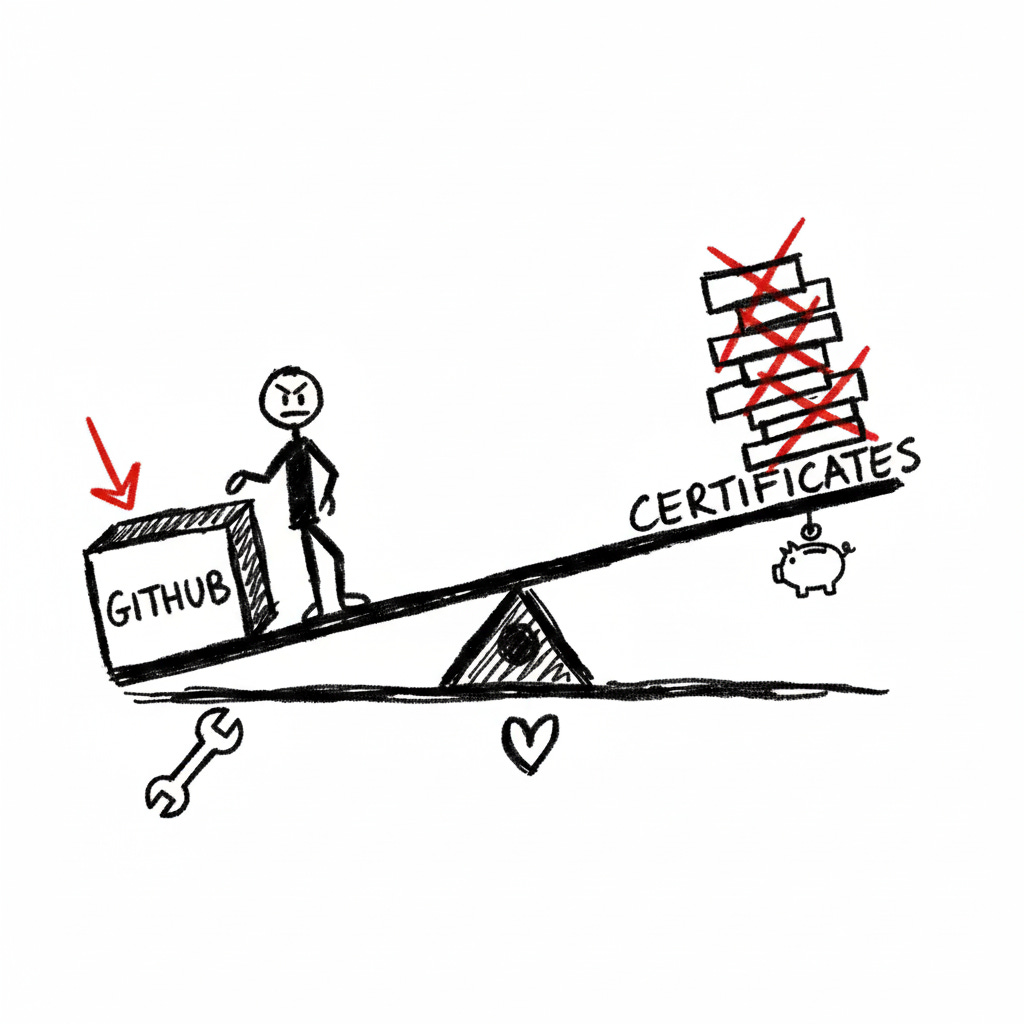
Stop “credential hoarding“ and start building Proof of Work. I have never once seen a “Certified Snowflake Expert“ badge solve a data quality issue, but I’ve seen plenty of engineers with zero certifications save a company millions because they actually understood how their systems were wired together.
The industry wants you to be a “Certified Professional“ because professionals follow manuals. But the market rewards undeniable engineers who know exactly why the manual is wrong.
Which one do you want to be?
Thanks for reading,
Yordan
PS: A certification is a subscription to a treadmill. Once you start, you have to keep paying the “recertification“ fee every two years just to prove you haven’t forgotten how to read a pricing table.
PPS: If you’re tired of the “paper trophy” treadmill and want to actually build the technical intuition that makes certifications irrelevant, this is how can I help.
This article comes at the perfect time, thank you for so eloquently articulating the deep truth about credentialing versus real competentce.
Couldn’t agree more. Certifications tend to focus on vendor-specific tooling rather than building strong foundational concepts.