


If you work with young data engineers, you have seen how quickly a project conversation can turn into a tool conversation. A new framework looks promising, someone shares benchmarks, and suddenly the center of gravity shifts from the business constraint to the elegance of the stack.
Revenue depends on the output, but the team, debates flexibility, long-term architecture, and developer experience without ever pricing the operational risk of introducing something new.
This is where delivery starts to drift.
Curiosity built your career. It sharpens judgment and expands range. But when exploration reaches production without structure, you trade certainty for novelty. You expand surface area, increase migration debt, and load more operational responsibility onto the team while calling it progress.
At senior level, tool adoption is not a technical preference. It is a risk decision. If you want more scope and authority, you have to treat it as such. You price the risk, you define ownership, and you protect delivery from avoidable instability.
In this piece, I will show you how to evaluate new tools through business constraint, blast radius, and explicit ownership so curiosity strengthens your leverage instead of diluting it.
Curiosity Is Not the Problem
Tool obsession gets framed as immaturity, but it rarely is. When you chase tools, you usually do it because you care about craft. You want better abstractions, cleaner interfaces, faster iteration.
That instinct built your competence.
The problem starts when your curiosity operates without a boundary.
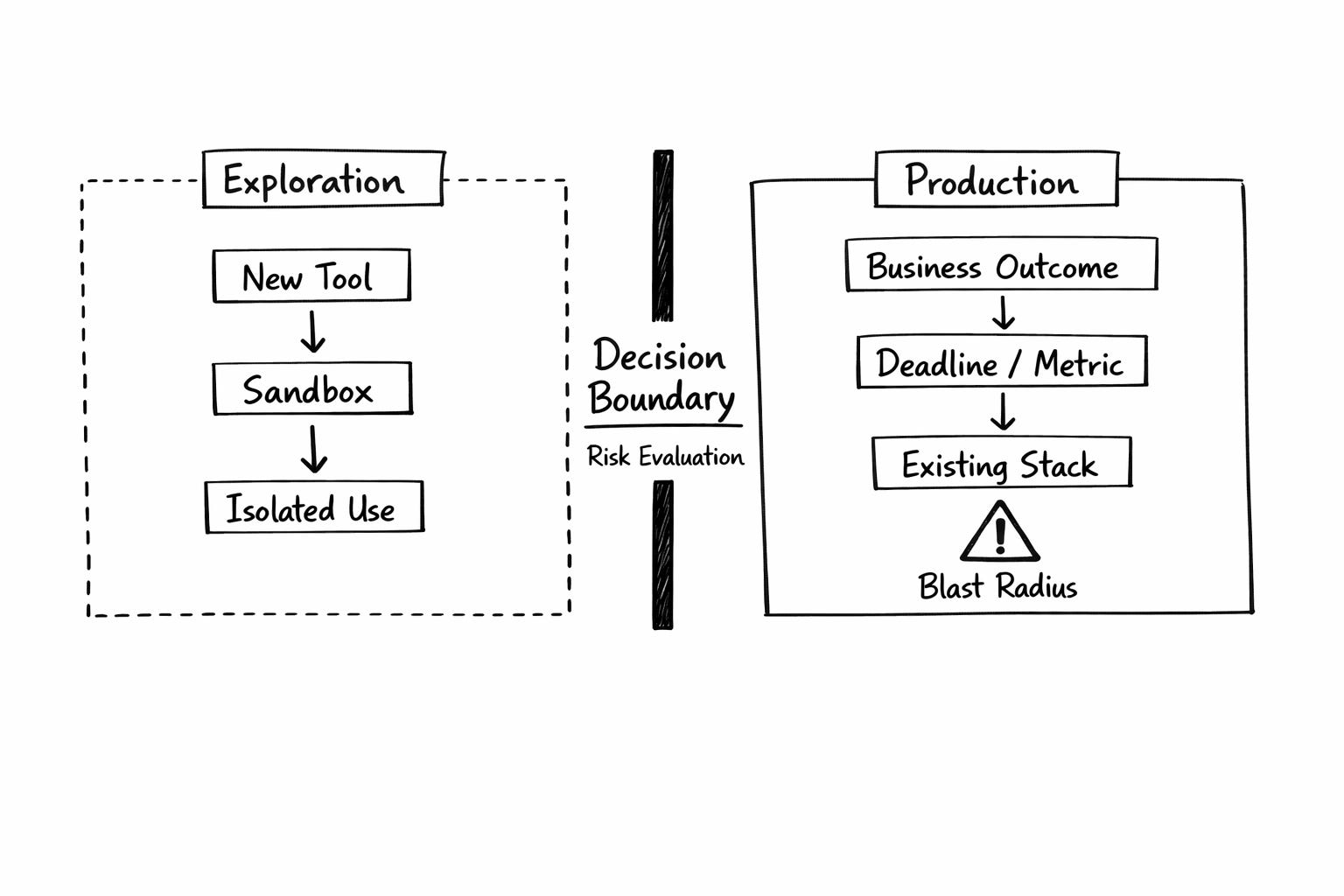
Exploration inside a low-risk environment compounds skill, but exploration inside an urgent production path compounds exposure. Those are two different games.
Technical peopl blur them when no one forces a distinction. So timelines stretch, incident probability rises, and migration work appears later as “unexpected complexity.”
Curiosity without structure also shifts decisions toward preference. The most excited voice often pulls the stack in its direction. The discussion feels collaborative, yet the downside remains unassigned. When integration drags or operational load spikes, ownership diffuses.
Authority grows when you protect the project before you protect your preferences. That does not reduce curiosity. It channels it. You can experiment where failure is cheap and reversibility is high, but you need to constrain yourself where business dependency is tight.
Once you internalize that distinction, tool conversations change. They move from elegance to exposure. That shift alone raises your leverage.
Tools Drift In When You Don’t Anchor to the Outcome
Tool debates expand when the outcome is not acting as a constraint.
If the project has a clearly named owner, a hard deadline, and an exposed business metric, the room behaves differently. The question shifts from “Is this a better framework?” to “Does this increase or decrease the probability we hit the outcome?”
Without that anchor, every tool looks viable. You evaluate it on elegance, future flexibility, and technical appeal because nothing forces you to evaluate it on risk.
This is about incentives. Engineers optimize for the dimension that is visible and measurable. If the business constraint stays abstract, the technical dimension becomes the dominant one.
The moment you name who carries the metric and who absorbs the failure, the conversation tightens. A new tool now competes against timeline risk, operational load, and migration debt.
As a senior engineer, you control that anchor. You either allow the stack to become the center of gravity, or you force every decision to orbit the outcome.
When the outcome leads, tool obsession shrinks on its own and you become a real operator.
Price the Tool Before You Adopt It
At senior level, adopting a new tool is a capital allocation decision. It consumes time, attention, migration bandwidth, and operational headspace. Treat it that way.
Before you say Yes to a tool, force three evaluations: business constraint, blast radius, and ownership of downside.
1. Anchor to the Business Constraint
Start with the outcome that pays for the work:
What decision depends on this project?
What deadline creates pressure?
What breaks if you miss?
If the constraint is time and credibility, introducing a new tool increases exposure unless it materially improves the probability of hitting the deadline.
If the constraint is long-term maintainability on a system with no immediate external dependency, the calculus changes.
This step protects you from aesthetic decisions. It forces you to evaluate the tool against the only dimension that matters in context: outcome probability.
When the constraint is explicit, half of the “modernize the stack” energy dissolves. The question becomes simple. Does this increase the odds of success under this constraint?
2. Map the Blast Radius
Every tool expands surface area.
Ask yourself:
How many production workflows will depend on this?
How hard is rollback?
How many engineers need to learn it?
What happens at 2 a.m. when it fails?
Reversibility matters more than elegance. A tool that is easy to unwind carries different risk than one that becomes foundational infrastructure. The larger the dependency graph, the more disciplined you need to be.
Senior engineers build leverage by reducing irreversible decisions in high-pressure paths. If the blast radius is wide and the timeline is tight, the responsible move is often restraint.
This is not conservatism. It is exposure management.
3. Assign the Downside Explicitly
Every tool decision has a future owner:
Who handles migration debt six months from now?
Who maintains the integration surface?
Who is on call when the abstraction leaks?
If the answer is “the team”, ownership is diffused. Blurry ownership weakens decision quality. When a specific person carries operational load and reputational risk, the evaluation sharpens.
Make the downside visible before you commit. Name it. If no one is willing to carry it, the decision is premature.
This framework does not suppress curiosity, but raises its quality. You can still explore aggressively in environments where failure is cheap and isolation is strong. In production paths with tight constraints, you default to stability unless the upside clearly dominates the risk.
That discipline is what expands your authority over time. Leaders trust engineers who manage exposure. Once that trust compounds, you gain more room to innovate where it actually pays.
Separate Exploration From Production
Curiosity needs space, but production needs protection. If you mix the two, you corrupt both.
Exploration works when failure is cheap, time is flexible, and reversibility is high. Production work carries external dependency, executive visibility, and downstream consumers who assume stability. Treating both environments the same creates avoidable volatility.
As an engineer, you control that boundary.
Create explicit exploration lanes. Time-box spikes. Isolate experiments behind feature flags or in non-critical workflows. Write short decision memos before promoting anything into production paths. Force yourself to articulate why the upside justifies the exposure.
This structure increases innovation quality. It filters out tool adoption driven by novelty and surfaces tool adoption driven by leverage.
Production lanes require a different posture. Here you optimize for predictability, observability, and rollback safety. You reduce moving parts during critical windows. You favor boring technology when the business constraint is tight. You treat stability as an asset, not a lack of ambition.
When you separate these lanes, you remove false tension. Engineers stop feeling blocked because experimentation still exists. Leadership stops feeling exposed because production paths remain controlled.
Over time, this separation compounds trust. People learn that your stack evolves intentionally, not reactively. They see that new tools appear where they create advantage, not where they create noise.
That reputation buys you freedom. It expands your decision surface instead of shrinking it.
Final Thoughts
The market rewards the engineer who protects outcomes under constraint.
Early in your career, range creates upside. You learn new frameworks, test abstractions, and expand your technical vocabulary. That phase builds capability. At senior level, capability alone stops differentiating you. Exposure management does.
Authority grows when people see that your systems behave predictably under pressure. It grows when urgent work ships without architectural detours. It grows when innovation appears intentional instead of impulsive.
Tool curiosity remains an asset. The difference is that you stop expressing it everywhere. You deploy it where reversibility is high and constraint is loose. In production paths tied to revenue, reputation, or executive trust, you optimize for stability unless the upside clearly dominates the risk.
That shift marks the transition from enthusiast to operator.
Over time, operators gain more freedom than enthusiasts. Leadership gives them larger scopes, earlier involvement in strategy, and more autonomy in technical direction because they protect the business first.
In the end, your stack does not define your seniority. The way you manage risk does.
Thanks for reading,
Yordan
PS: If you want the operator playbooks behind these essays, premium access is $48 for my birthday and expires tomorrow. It includes the frameworks senior data professionals use to expand scope and compensation.